
Water Damage Restoration in St. George, LA
Water damage in a St. George house rarely announces itself all at once: a supply line weeps inside a wall, a water heater gives out in the night, a storm lifts shingles, or a slab leak shows up as a warm, damp patch of floor. Water damage restoration is the work of getting that water out and the structure dry before mold has a chance to start, while keeping as much of the house as can be kept. St. George Mold Remediation books that drying work and, if growth has already begun, sets up the independent assessment and separate remediation the law requires. Call (225) 285-3983.
Call (225) 285-3983 Request a callback
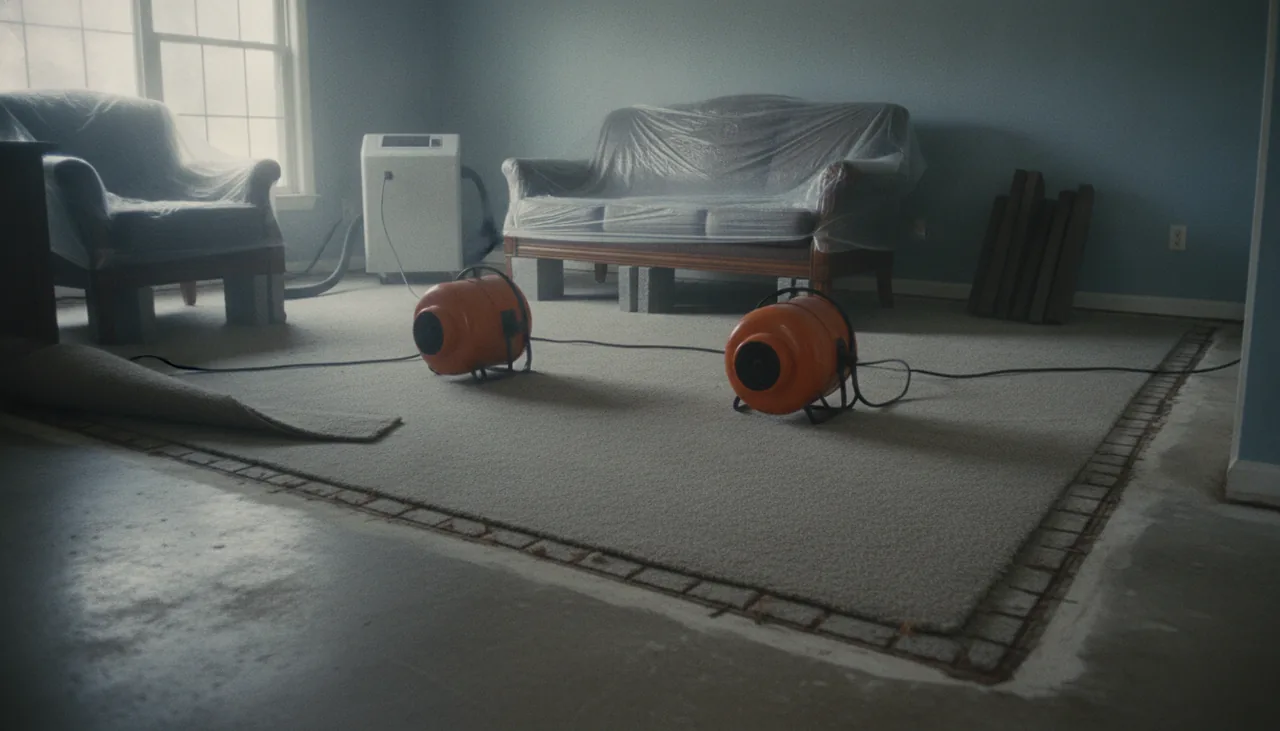
The first hour of water damage, before anyone arrives
A few things cost nothing and make every later step smaller. None of them involve cleaning; they are about stopping the water and keeping a record of it.
- Close the main shut-off. It is usually in the meter box near the street or where the line comes through the wall; for a leaking water heater, the cold inlet valve on top stops the flow.
- Turn off the breakers for any room where water has reached outlets, cords or floor-level appliances.
- Photograph and film every wet room, the source and anything damaged before it is moved. Adjusters ask for those images first.
- Get furniture legs up onto blocks or foil, and take rugs, boxes and paper off the wet floor.
- If the air handler closet took water, or ducts run under a soaked floor, leave the system off until someone has looked at it.
- Keep receipts for tarps, a hotel night or anything else the loss forces you to buy.
Then call and say what failed, roughly when, and which rooms are wet. The person on the line uses that to decide whether the visit is a drying job, a mold job or both.
How water damage drying is measured, not guessed
The Louisiana Department of Health's guidance is to dry water-soaked building materials and contents within 24 to 48 hours, because mold growth becomes likely after that. The drying crew works against that clock, and every step below is written down so an adjuster, or a later buyer, can follow it.
Mapping. Water spreads sideways under vinyl plank and laminate, climbs drywall by wicking and settles into the bottom plate of a wall. A moisture meter and a thermal camera find the edge of the wet area, and that edge goes onto a sketch of the house with a reading at each point.
Extraction. Standing water is pumped out and carpet is extracted with a weighted tool. Carpet pad holds water like a sponge and is nearly always thrown away; on a clean-water loss the carpet above it can sometimes be kept.
Removal of what will not dry. Swollen particleboard cabinet bases, soaked insulation and the bottom band of saturated drywall are cut out so air can reach the framing behind them.
Drying. Dehumidifiers and air movers run with the house closed up. Readings are logged each day and compared with a dry wall in an unaffected room, which sets the target.
Sign-off. Nothing is closed, painted or re-floored until the framing and subfloor read at that dry target. Sealing a damp wall is how a water job turns into a mold job a few months later.
Drying in St. George takes longer than it would in a drier climate, because the outdoor air already carries a lot of moisture for much of the year.
NOAA's 1991-2020 normals for the airport station record measurable rain on about 114 days a year and an inch or more on about 19, with June the wettest month at 6.45 inches. Between storms the July and August dew point averages about 73°F, so dehumidifiers carry most of the drying load.
Clean, grey or black water damage: the source sets the scope
Drying contractors sort every loss by what the water carried, because that decides what can stay in the house.
Clean water comes from a supply line, an ice-maker tube, a water heater tank or rain through a fresh hole in the roof. Most drywall, framing, cabinets and hardwood can be dried and kept if the work starts inside the window above.
Grey water comes from a washing machine discharge, a dishwasher or a toilet tank overflow. It carries soap, food and dirt, so carpet, pad and other porous things it soaked are usually discarded, and hard surfaces are cleaned before drying begins.
Black water is sewage, a backed-up drain line, or water that rose from outside after crossing yards, streets and ditches. Anything porous it reached is removed, and the space is cleaned and disinfected before the dehumidifiers go in. A house near Ward Creek, Dawson Creek or Bayou Manchac that takes rising water belongs in this group even when the water looks clear.
Time changes the category as well. Clean water left standing in a warm, closed house for a few days picks up enough bacteria and debris to be handled as grey, which is one more reason the first call matters more than the first estimate.
When water damage has already become mold
If the call comes after a long weekend away, or the smell arrived before anyone noticed the leak, the job is no longer only drying. Louisiana treats mold work differently from water work. Under La. R.S. 37:2158(A)(23), a company that assesses mold on a property may not also remediate it there, or own part of the firm that does. So the order is fixed: an independent assessment firm measures the moisture, maps the growth and writes the protocol; a separate remediation contractor follows that protocol under containment; and someone other than that contractor checks the result before the walls are closed.
St. George Mold Remediation is the phone line behind this page, not a crew. It books each of those firms, keeps them apart as the statute requires, and holds the drying record, the assessment and the clearance result together for the claim. More on each stage: mold inspection, mold remediation and, for water that rose from outside, post-flood mold remediation.
Water damage insurance: homeowners policy or flood policy
Which policy answers depends on where the water came from, not on how much of it there was.
- Inside the house, sudden. A burst pipe, a failed water heater, a washing machine hose that split, or storm wind opening the roof with rain following it: the homeowners policy is the one to call. Many policies cap what they pay toward mold that follows, so the cause and the dates matter.
- Inside the house, slow. A drip under a sink for months or a shower pan that seeped for years is often excluded as wear, though the sudden damage it finally causes may still be paid.
- From outside, rising. Water that came over the ground from a creek, a ditch or a flooded street is flood. Homeowners policies exclude it; it needs a flood policy through the National Flood Insurance Program or a private carrier, and a new flood policy usually has a waiting period before it starts.
- Up through the drains. Sewer or drain backup is usually a separate endorsement on the homeowners policy, with its own limit.
Whichever policy applies, the adjuster asks for the same four things: the cause, photos from before anything moved, daily moisture readings and an itemized scope. A proper drying record covers all of them. Flood cover also turns on the flood zone the house sits in, which a lender checks at closing.
St. George joined the National Flood Insurance Program as its own community on April 1, 2026, entering the Community Rating System at Class 9, a 5% premium discount, and it uses the parish flood maps effective June 19, 2012 (FEMA). About 15% of the parish's August 2016 flood claims came from buildings rated in moderate- or low-risk zones, so a house outside the high-risk area can still take rising water.
What water damage restoration costs in St. George
Drying is the inexpensive part of a water loss; the bill climbs when the water is left to sit. Typical St. George ranges:
- A small clean-water loss, such as one supply line caught early, extracted and dried: $800 to $2,500.
- Water that spread through several rooms before anyone caught it: $3,000 to $8,500.
- Sewage or backwater adds 50 to 100 percent to either range, because far more material is removed and the space is disinfected.
The levers are how much water there was, how long it stood, which category it was and how much of the house had to be cut out. Mold work, if the water got that far, is priced on its own after the assessment; see the cost page. These figures come from earlier jobs in the area and are not a quote: the drying contractor prices your rooms in writing once someone has seen them.
Booking water damage help with one phone call
Call (225) 285-3983 with the address, what failed, when it was noticed, which rooms took water, whether it is still coming in and whether a claim number exists yet. Staff are at the office from 8 in the morning to 6 in the evening on weekdays and from 9 to 2 on Saturdays, but the line itself picks up at any hour, which counts when a pipe lets go on a Sunday night. If writing is easier, the callback form below and the contact page reach the same people.
Water damage questions from St. George owners and renters
How much does water damage restoration cost in St. George?
A small clean-water loss that is extracted and dried early runs $800 to $2,500. When several rooms took water the range is $3,000 to $8,500, and sewage or backwater adds 50 to 100 percent. Any mold work is priced separately after an assessment. Call (225) 285-3983 and describe the rooms for a closer range.
Who does the drying, and who handles mold if it has started?
A drying contractor handles extraction and dry-out. If growth has begun, La. R.S. 37:2158(A)(23) keeps the mold assessment and the removal with different companies, so an independent assessor writes the plan and a separate remediation contractor carries it out. One call to (225) 285-3983 books the firms the house needs.
Will homeowners insurance pay for water damage?
Usually, when the cause was sudden and inside the house, such as a burst pipe or a failed water heater, often with a cap on mold. Slow leaks are often excluded, and water rising from outside needs a flood policy. Ring (225) 285-3983 before the adjuster visits so the drying record starts on day one.
Is it worth paying for drying on a small leak?
If the water stayed on tile and never reached a wall, a cabinet base or the underside of flooring, often not. If it soaked into any of those, a moisture reading settles it, because household fans dry the surface and leave water inside the material. Call (225) 285-3983 and ask for a moisture check if you are unsure.
I rent the house. Do I call about water damage, or does the landlord?
Tell the landlord or manager in writing the day it happens, with photos. The owner normally answers for the building and its repairs, and a renters policy covers your belongings. Either of you can phone (225) 285-3983 to set up the visit, with the owner agreeing before anything is removed.
We are selling a house that had a leak. What should the buyer see?
A buyer's inspector will look for traces of it, and the seller's disclosure should match what happened. Paperwork answers better than memory: the cause, the repair invoice, the readings that show the house was dried, and any mold clearance result. If the file has gaps, call (225) 285-3983 about an independent check before the house is listed.
Request a Callback
Writing it down suits some people better, and so does sending it after office hours. Put the details in here and a phone call comes back to you.
Talking it through instead? (225) 285-3983 picks up day or night; give the street address and what is wrong, and someone rings you back.
Water in the house right now?
Shut off the source if you can, then call (225) 285-3983 with the address and how long the water has been there.
Call (225) 285-3983