
Black Mold Removal in St. George, LA
Dark growth in a ceiling corner, along the bottom of a closet wall or on the plywood under a kitchen sink is what most St. George homeowners call black mold, and black mold removal here starts with one phone call. St. George Mold Remediation sets the job up in the order Louisiana requires: an independent assessor looks first and writes down what is wet and what has grown, a separate remediation contractor takes out the affected material, and someone outside that contractor checks the finished area. You see each step and the price before any drywall is cut. Call (225) 285-3983.
Call (225) 285-3983 Request a callback
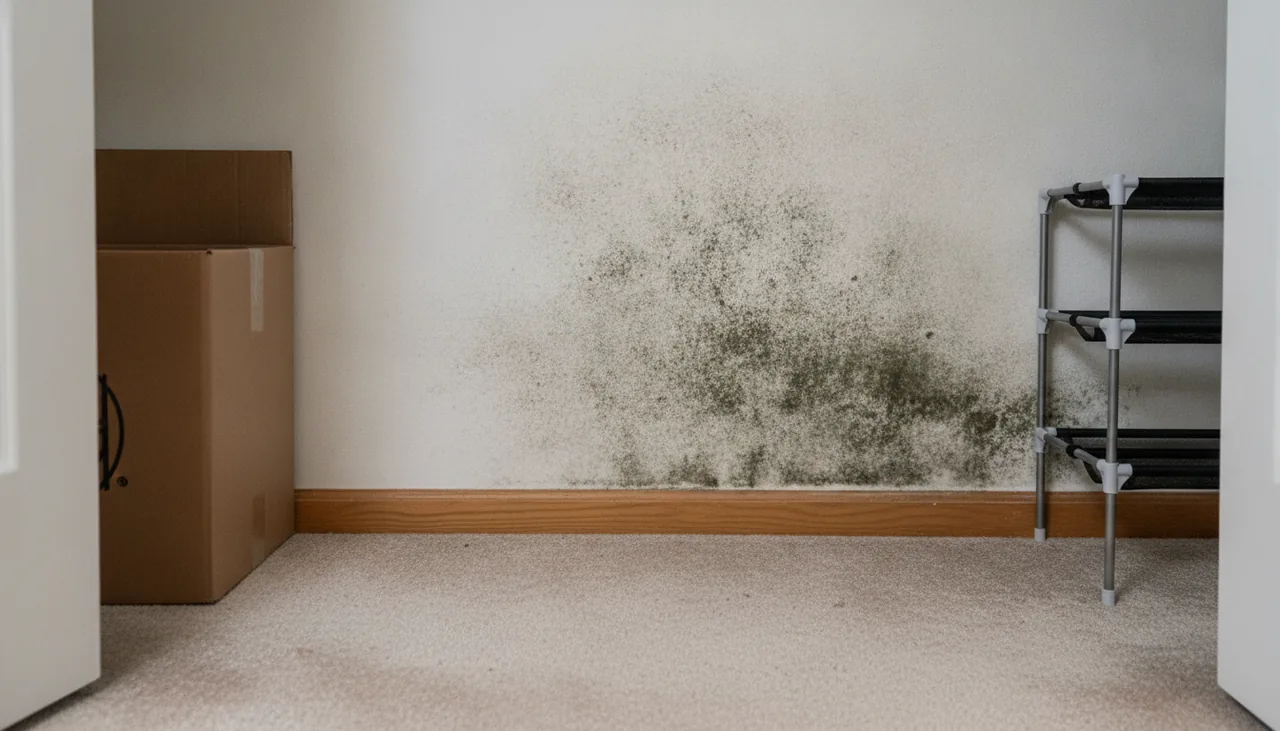
What the dark growth called black mold usually is
"Black mold" is a household name, not a lab result. Several ordinary indoor molds turn dark green, charcoal or black as they mature, and on the paper face of drywall, on painted plaster, on pine studs or behind vinyl wallpaper they look almost alike. Colour does not name the species, and the species seldom changes the removal plan. What sets the plan is the material the growth sits on and the water feeding it: a weeping supply line inside a vanity, roof flashing that lets rain reach a ceiling, or an outside wall that stays cool while the air conditioner runs and indoor moisture condenses on it.
Discoloured paint that never darkens again after a leak is repaired may be an old stain rather than live growth. A moisture reading and a close look at the drywall paper usually tell the two apart, which is one reason the assessment comes before any quote for removal.
Weather plays its part in how often this turns up in St. George houses.
The airport weather station averages 61.94 inches of rain a year, 17.91 of them in June through August (NOAA 1991-2020 normals), and the July and August dew point sits near 73°F. A closet wall chilled by air conditioning on the far side, or a ceiling under a cold supply duct, stays below that dew point for weeks at a stretch.
Who handles black mold removal, and why there are two firms
Louisiana keeps diagnosis and removal apart. Under La. R.S. 37:2158(A)(23), the company that remediates mold on a property may not be the company that assessed it, and it may not own a stake in that firm. So the work runs in three parts. An independent assessment firm measures moisture, photographs the growth and writes a protocol. A separate remediation contractor prices that protocol and does the removal. Once the work is finished, a person who is not on that contractor's payroll checks the area before new drywall goes up.
St. George Mold Remediation is the phone line and website that books those parts in order and keeps the paperwork together for the owner. It does not inspect or remove mold itself, which is exactly what lets the assessor's report stay neutral about how large the job should be.
Where black mold turns up in St. George houses
- Bathroom ceilings above the shower, and the drywall behind a tub surround; see bathroom mold removal.
- Closets built against an exterior wall, where clothes block air from reaching the cool corner.
- Behind the refrigerator and under the kitchen sink, where an ice-maker line or a drain slip joint drips unseen.
- Window sills and the drywall below them, after years of condensation running down the glass.
- The underside of the roof deck and the tops of ceiling joists; see attic mold.
- Floor joists and subfloor under a raised house; see crawl space mold.
- Supply grilles and ceiling paint around them, which points to the cooling system; see HVAC mold remediation.
How old the house is and how it was built changes where the assessor looks first.
Shenandoah and Old Jefferson, two of the larger established neighborhoods, both have a median home built in 1989 (Census ACS 2019-2023). Houses of that age have had decades of roof, plumbing and window wear, and that history often explains a patch of dark growth; in newer subdivisions the cause is more often the air conditioning or a slab-edge leak.
How black mold removal is done on drywall, ceilings and wood
Sealing the room. The contractor hangs plastic sheeting with a zippered door and runs a HEPA-filtered air machine that pulls air out of the work area, so dust travels toward the filter instead of down the hallway. The supply vent in that room is covered.
Cutting out what the growth has entered. Drywall, ceiling board and wet insulation are removed a little past the last visible edge, bagged inside the plastic and carried out sealed. Growth on the back of a sheet is often wider than what shows on the painted side, so neighbouring wall bays get opened or metered too.
Treating the wood that stays. Sound studs, joists and subfloor are not torn out. Surface growth is sanded or blasted off, the framing is HEPA-vacuumed, and dehumidifiers run until the wood meets the drying target written in the protocol.
Fixing the water. A plumber or roofer repairs the source before anything is closed up. Without that repair the job only buys time.
Checking the result. Someone independent of the remediation contractor looks at the opened area and, when the protocol asks for it, takes clearance air samples. Rebuild starts after that check passes. More detail sits on the mold remediation page.
Living at home during black mold removal
For a closet, one bathroom wall or a single bedroom, most families stay in the house. The plastic enclosure holds the work zone apart, the crew keeps to one path between the door and the room, and the kitchen and other bedrooms carry on as normal. Expect a steady hum from the air machine and dehumidifiers, a closed door with sheeting behind it, and a few days of workers coming and going. Keep pets well away from the enclosure.
When growth has spread through several rooms or into the air handler, the contractor may ask you to be out on the days material is removed, and the written protocol says so ahead of time so you can plan. Nothing about the schedule should come as a surprise on the morning work starts.
What black mold removal costs in St. George
The assessment with a written report runs $300 to $600, or $450 to $850 when one or two air samples are added. A surface sample to identify the growth costs $40 to $80 with the lab fee. Removal of an area under 10 sq ft is typically $500 to $1,500. A whole closet or bedroom runs $1,200 to $3,800, and a bathroom opened behind the tile $1,500 to $4,500. A slab-edge cavity is $2,000 to $7,000, an attic $2,500 to $8,000, and a whole-house HVAC and duct job $6,000 to $20,000. Clearance testing afterwards is $200 to $400.
These ranges come from earlier St. George jobs and are estimates, not quotes. The figure you sign comes from the remediation contractor after reading the assessment, and it can land above or below them. The full list is on the cost page.
Starting black mold removal with one call
Ring (225) 285-3983 and describe where the dark growth is, roughly how large it looks, whether it returns after painting, and whether the house is rented, under contract to sell or part of an open insurance claim. Office hours are Monday to Friday 8 a.m. to 6 p.m. and Saturday 9 a.m. to 2 p.m., though the line picks up at any hour. If writing suits you better, use the form below or the contact page.
Black mold removal questions from St. George owners
How much does black mold removal cost in St. George?
A patch under 10 sq ft usually runs $500 to $1,500 and a full bedroom or closet $1,200 to $3,800; attics and cooling systems cost more. The assessment comes first at $300 to $600. For a range that fits the dark patch in your own house, call (225) 285-3983.
Who removes the black mold if this company does not?
A separate remediation contractor, working from a protocol written by an independent assessor, because La. R.S. 37:2158(A)(23) keeps those roles apart on one property. Call (225) 285-3983 and the assessor and the contractor are booked in that order.
Do I need a lab test to know what kind of black mold it is?
Only when someone needs it on paper, such as a buyer, a tenant, a landlord or an adjuster. The removal method follows the material and the water, not the species, and a surface sample is $40 to $80. Call (225) 285-3983 to ask whether sampling would settle your question.
Will homeowners insurance pay for black mold removal?
That depends on the policy and on the cause. Sudden water such as a burst supply line is usually treated differently from a slow drip or humidity, and many policies cap mold coverage. The adjuster reads the independent assessment, so call (225) 285-3983 to have it done before the claim is filed.
We are buying or selling a house with black mold. What should happen first?
Book the assessment while the inspection period on the contract is still open. Its report gives both sides a written scope to price, and a clearance check by someone outside the contractor gives the buyer paper at closing. Call (225) 285-3983 with the closing date in hand.
Who arranges black mold removal in a rented house, the landlord or the tenant?
Usually the owner, since the walls and the leak belong to the building, but either one can request the assessment, and its report is what both read from. Landlords and tenants can each call (225) 285-3983 to get the visit on the calendar.
Request a Callback
Writing it down suits some people better, and so does sending it after office hours. Put the details in here and a phone call comes back to you.
Talking it through instead? (225) 285-3983 picks up day or night; give the street address and what is wrong, and someone rings you back.
Dark growth on a wall or ceiling?
Call (225) 285-3983. The patch is assessed by one firm and cut out by another, as Louisiana law sets it up.
Call (225) 285-3983