
Mold Remediation in St. George, LA
Mold remediation is the controlled version of mold removal: the work area is sealed off, materials the growth has rooted into are cut out and bagged, framing that stays is cleaned, the space is dried to target readings, and the result is checked by someone other than the crew that did it. St. George Mold Remediation arranges that sequence for houses and buildings in the City of St. George, starting from an independent assessor's written protocol and ending with a clearance check. The contractor doing the removal is a separate company, as Louisiana law requires. Call (225) 285-3983 to start.
Call (225) 285-3983 Request a callback
When mold remediation is needed, and when a smaller fix will do
Not every patch of growth calls for a sealed work area and a crew. An assessor's report usually sorts the situation into one of three outcomes, and the difference in price between them is large.
- Repair the water and watch. Light surface growth on a hard, sealed material, with the leak already fixed, may need nothing more than a contractor's small-area cleaning and a return look after some weeks.
- Small-area work. Less than 10 sq ft of affected material, a limited enclosure and a short visit.
- Full mold remediation. Growth inside drywall, insulation, carpet pad or ceiling board; anything in a crawl space, attic or duct system; or growth that keeps returning after cleaning.
The deciding question is rarely how alarming the mold looks. It is whether the material can be cleaned where it is or must be cut out, and whether the moisture behind it is still active. A protocol that answers both keeps you from paying for a large job you did not need, or for a small one that has to be repeated.
How a mold remediation job runs, stage by stage
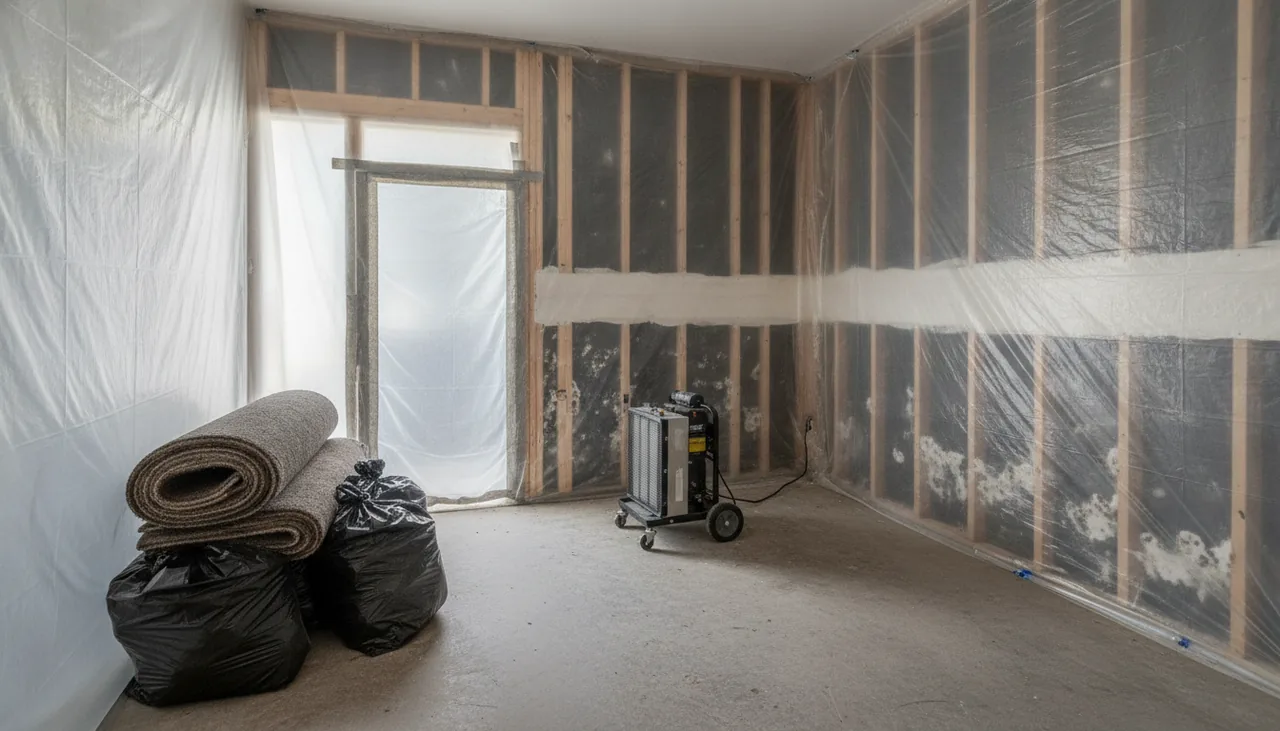
- Isolation. Plastic sheeting walls off the affected rooms, with a zip door for the crew. Supply and return grilles inside the area are taped over so the air conditioner cannot carry debris through the house. A negative-air machine with HEPA filtration exhausts the enclosure, so air moves into the work area and not out of it.
- Tear-out. Drywall, insulation, padding and trim with growth in them are cut back beyond the visible edge, bagged inside the enclosure and carried out sealed.
- Framing and subfloor. Wood that stays is sanded or HEPA vacuumed until the surface is sound, then left open so it can dry.
- Drying. Dehumidifiers and air movers run until moisture readings in studs, plates and subfloor reach the target written into the protocol. Closing a wall over damp wood simply restarts the problem.
- Detail cleaning. Every surface inside the enclosure is HEPA vacuumed and damp-wiped, because fine debris settles well away from where growth was visible.
- Clearance. Someone independent of the remediation contractor looks over the area and, on larger jobs, compares an air sample from inside the enclosure with one taken outdoors. The plastic stays up until the area passes.
Rebuild work, meaning new drywall, tape, paint and trim, sits on its own line of the quote so you can see what the remediation by itself costs.
Where St. George mold remediation jobs tend to be
Where a job lands in a building follows how it was put together and how water reaches it.
In St. George that usually means a single-family house: roughly 72% of housing units are detached homes, and the 1980s and the 2000s were the busiest building decades, at about 21% of today's stock each (Census ACS 2020-2024, city estimate). Westminster is the oldest of the established neighborhoods, with a median build year of 1973.
- Lower walls of slab houses. Water entering along the slab edge from irrigation, a downspout or a slab leak soaks the bottom of the drywall and the sill plate. If the wall is still wet, start with water damage restoration.
- Under raised houses. Joists and subfloor above damp ground; see crawl space mold.
- Behind showers and tubs. A slow seep from a pan or valve; see bathroom mold removal.
- Roof deck and attic insulation. Roof leaks and exhaust fans that end in the attic; see attic mold removal.
- Air handler, coil and ducts. See HVAC mold remediation.
- Whole floors after high water. See post-flood mold remediation, and for dark growth specifically, black mold removal.
The two-company rule for mold remediation in Louisiana
La. R.S. 37:2158(A)(23) bars a mold remediation contractor from also assessing the property it works on, and from holding a stake in the firm that did assess it. In practice that puts two businesses on every St. George job: an independent assessor who writes the protocol and a separate contractor who carries it out. A final check, by someone other than that contractor, closes the file.
The benefit to you is that the scope is set by a firm with nothing to gain from enlarging it. The contractor's bid has to line up with a document you can hand to an adjuster, a buyer, or a second contractor for comparison, and the mold inspection page explains what that document contains.
Mold remediation cost in St. George
Ranges this site uses for remediation work: a small area under 10 sq ft, $500 to $1,500; a closet or bedroom, $1,200 to $3,800; a bathroom opened behind the tile, $1,500 to $4,500; a slab-edge cavity, $2,000 to $7,000; an attic, $2,500 to $8,000; an air handler and coil, $1,500 to $5,500; a whole system with its ducts, $6,000 to $20,000. Clearance at the end runs $200 to $400, or $100 to $200 per room if only samples are taken.
All of these are estimates from earlier jobs. The remediation contractor's written number, given after reading the protocol, is the one to budget around, and the cost page sets out every row with what moves it.
Starting mold remediation at a St. George property
Call (225) 285-3983 and explain where the growth is, roughly how large an area it covers, and whether the leak behind it has been repaired. If an independent firm has already assessed the property, keep the report at hand, because the remediation contractor can price from it. If no assessment exists yet, the call books that first. The callback form below works as well.
Mold remediation questions
What is the difference between mold removal and mold remediation?
Removal means taking out material the growth has damaged. Remediation is the whole controlled job around it: enclosure, tear-out, cleaning, drying and a clearance check by someone else. Call (225) 285-3983 if you are unsure which one a quote describes.
How much does mold remediation cost for one room?
A closet or bedroom usually runs $1,200 to $3,800, and a bathroom opened behind the wall $1,500 to $4,500, with rebuild priced on a separate line. Call (225) 285-3983 for a range that suits the room.
Do we have to move out while the work is done?
For a single sealed room, most households stay put, since the enclosure keeps the work apart from living space. Several rooms at once, or a job on the air conditioning system, can mean a few nights elsewhere. Call (225) 285-3983 to talk through your layout.
Does a homeowners policy cover mold remediation?
If the growth came from a sudden covered loss such as a burst pipe, part of it may be paid, frequently up to a mold sublimit. Gradual leaks and humidity are usually left out. Call (225) 285-3983 and keep the claim number nearby.
Can the company that removes the mold also check its own work?
It should not grade itself. The assessment beforehand comes from an independent firm, and the clearance check afterwards from someone other than the remediation contractor. Call (225) 285-3983 and both are put on the calendar.
What keeps mold from returning after remediation?
Dealing with the moisture source. The protocol names the repair, whether a plumbing fix, a bath fan vented outdoors or a crawl-space liner, and remediation without it rarely lasts. Call (225) 285-3983 and the assessment gets booked before any tear-out.
Request a Callback
Writing it down suits some people better, and so does sending it after office hours. Put the details in here and a phone call comes back to you.
Talking it through instead? (225) 285-3983 picks up day or night; give the street address and what is wrong, and someone rings you back.
Need remediation rather than a wipe-down?
Ring (225) 285-3983. The assessor writes the protocol, a separate remediation contractor follows it, and someone else checks the result.
Call (225) 285-3983