
Mold Removal in Prairieville & Gonzales, LA
Prairieville lies across the parish line from St. George, in Ascension Parish, and this page is background for people living near that line rather than an offer of service there. The two places share low ground, long humid summers and the same rivers and bayous, so mold and water damage tend to follow similar patterns on both sides. What differs is the paperwork: the parish, the city limits, and which firms can be hired for which address. This line arranges mold work only for properties inside the City of St. George. If the property is in St. George, call (225) 285-3983.
Call (225) 285-3983 Request a callback
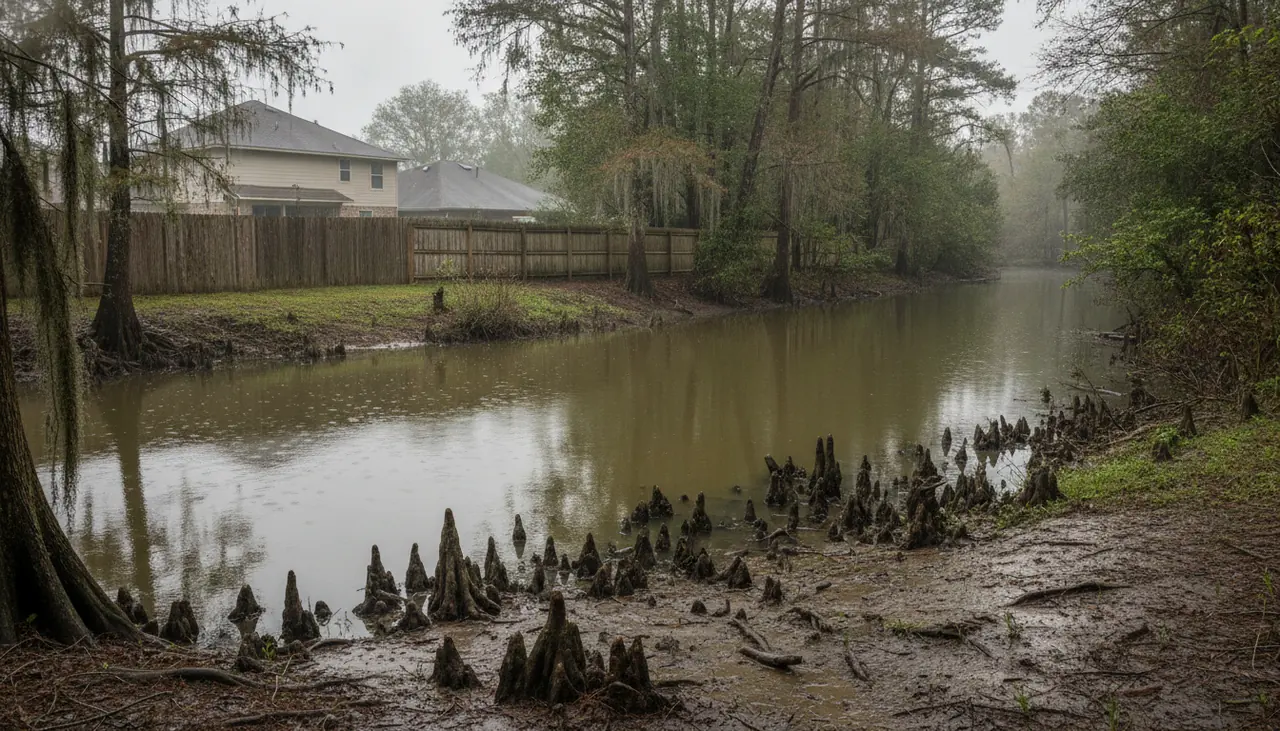
Prairieville and St. George: neighbors on opposite sides of a parish line
Prairieville is an unincorporated community in Ascension Parish. St. George is an incorporated city in East Baton Rouge Parish, and the Louisiana Supreme Court upheld its incorporation in 2024. For an owner near the boundary, that difference decides which parish government, which permit office and which local rules apply to the property. It also decides whether this line can help: it handles St. George addresses, and a Prairieville address is outside its area.
How water and mold problems in Prairieville compare with St. George
Low ground and slow drainage shape mold calls on both sides of the line. When the rivers and bayous run high, water backs up into yards, crawl spaces and slab-level rooms, and the damage that follows looks much alike in either parish: swollen baseboards, damp insulation, a smell that lingers in a closet long after the floor has dried.
Bayou Manchac marks the parish line where Interstate 10 crosses it, and the Amite River runs along the eastern edge of St. George. The ground is low on the St. George side too: in a sample of points inside the city the median elevation was about 22 feet, and 45% of points sat below 20 feet (USGS). Prairieville, across the bayou, grew from 26,895 residents in 2010 to 33,197 in 2020 (Census).
The bigger differences usually come from the houses rather than the ground. A newer slab house and an older raised house take on water in different places, so the age and build of a property often matter more than which side of the line it stands on.
In August 2016 the Amite River at Port Vincent, downstream of the parish line, hit an estimated record 17.45 feet, with water spreading south from Bayou Manchac across several state highways (National Weather Service). On the St. George side the Bayou Manchac Point gauge reached an estimated 21.50 feet. Prairieville's homes are newer on average than those north of the bayou, with a median build year of 2003 (Census ACS 2020-2024).
Wherever the address, timing counts. The Louisiana Department of Health points to a window of 24 to 48 hours for drying wet materials before growth takes hold, and that applies in Prairieville exactly as it does in St. George.
Is the address in Prairieville or St. George?
The mailing address is a poor guide. Postal town names and ZIP codes were set up for mail delivery, not to mark city or parish boundaries. These checks are more reliable:
- The parish assessor's record for the lot names the parish, because East Baton Rouge Parish and Ascension Parish each keep their own property rolls.
- A property tax bill shows which parish issued it.
- The City of St. George's boundary map shows whether a lot inside East Baton Rouge Parish is also inside the city.
- Bayou Manchac marks much of the line between the two parishes, so lots on opposite banks can sit in different parishes.
If the record says East Baton Rouge Parish and the city map puts the lot inside St. George, the line can arrange the work. The St. George service area page lists the neighborhoods and corridors inside the city.
If the property is in St. George, call (225) 285-3983.
What this line does for St. George properties near Prairieville
For an address inside St. George, the line sets up the work in the order Louisiana law requires. An independent assessment firm inspects and writes the scope; a separate remediation contractor prices that scope and does the removal; and someone outside the contractor's firm checks the result. La. R.S. 37:2158(A)(23) forbids one company from both assessing and remediating the same property, or from owning part of both. For an address in Prairieville or Gonzales, the line will say on the call that the property is outside its area.
If the property is in Prairieville: questions worth asking any mold firm
The state rule does not stop at the parish line; it applies in Ascension Parish too. Whoever an owner in Prairieville or Gonzales hires, a few questions help keep the job straight:
- Is the firm assessing the house independent of the firm that will do the removal?
- Does the written scope name the moisture source and say how it will be fixed?
- Who checks the work at the end, and does that person work for the contractor?
- Will the report and the clearance result come in writing, ready for a claim or a sale?
If the property is in St. George, call (225) 285-3983.
Prairieville and parish-line questions
Does this line arrange mold removal in Prairieville or Gonzales?
No. Prairieville and Gonzales are in Ascension Parish, outside the City of St. George, and this line handles St. George properties only. If the property is in St. George, call (225) 285-3983.
How can I tell whether an address is in Prairieville or St. George?
Check the parish assessor's record and the City of St. George's boundary map rather than the mailing address. If the property is in St. George, call (225) 285-3983 and the address will be checked again.
Is mold more of a problem in Prairieville than in St. George?
Not in any way that follows the parish line. Both sides are low and humid, and the build of a house and its water history matter more than its parish. If the property is in St. George, call (225) 285-3983.
Does the Louisiana assessment-and-removal split apply in Prairieville?
Yes. La. R.S. 37:2158(A)(23) is state law, so it applies in Ascension Parish just as it does in East Baton Rouge Parish. For a property inside St. George, call (225) 285-3983.
My St. George house is near the Prairieville side and took water. What should I mention on the call?
The street address, when the water came in and how high it rose, what has been removed since, and whether the house is on a slab or raised. If the property is in St. George, call (225) 285-3983 with those details.
I own one property in Prairieville and one in St. George. Can the line handle both?
Only the St. George one. The Prairieville property needs a firm working in Ascension Parish, with the same split between assessment and removal. For the St. George property, call (225) 285-3983.
Request a Callback
Writing it down suits some people better, and so does sending it after office hours. Put the details in here and a phone call comes back to you.
Talking it through instead? (225) 285-3983 picks up day or night; give the street address and what is wrong, and someone rings you back.
Is the property inside St. George?
If it is, call (225) 285-3983 about mold or water damage there. This line takes calls for St. George addresses only.
Call (225) 285-3983