
Emergency & Post-Flood Mold Remediation in St. George, LA
After a flood, the question in a St. George house is not whether something has to come out but how much, and in what order. Post-flood mold remediation starts with the source of the water, because rising water from a creek or a flooded street is handled very differently from a burst pipe, then removes what soaked it up, dries what is left and has the result checked before a single wall is closed. St. George Mold Remediation arranges each stage by phone and keeps the assessor and the remediation contractor in two independent firms, as Louisiana law requires. Call (225) 285-3983.
Call (225) 285-3983 Request a callback
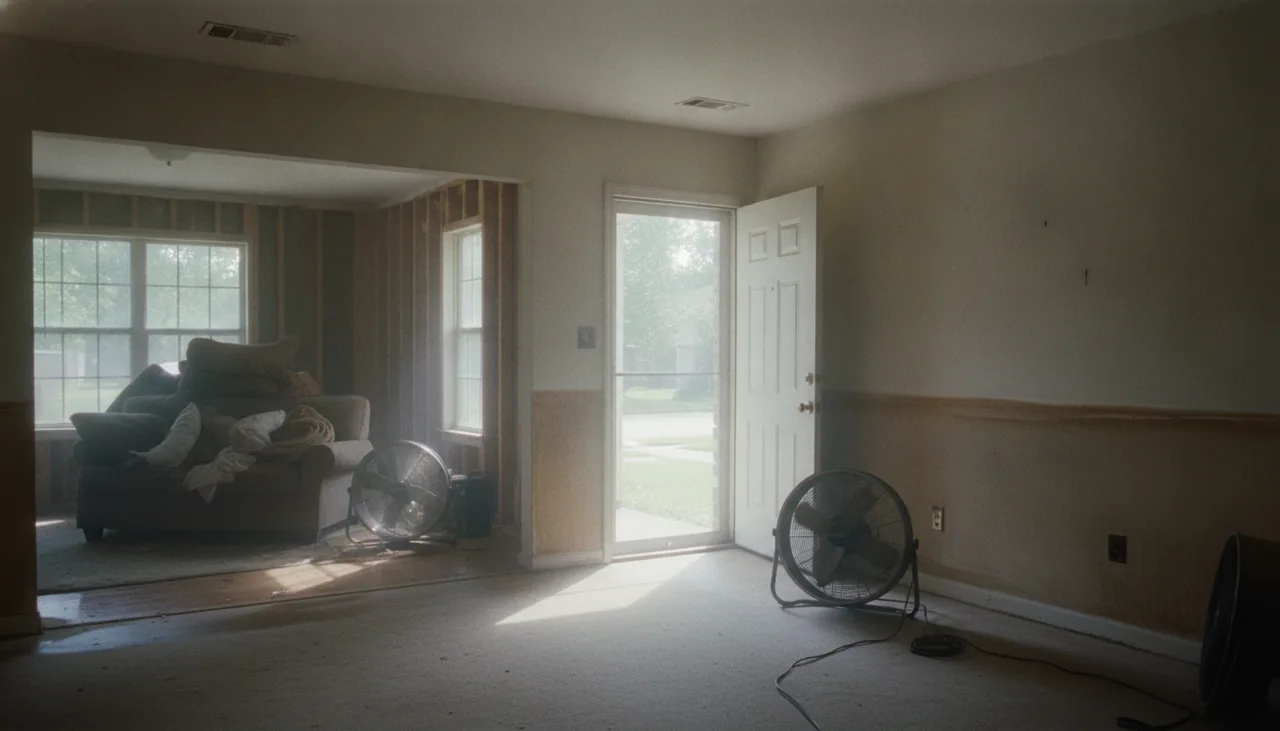
Rising water or a burst pipe: the first fork after a flood
Water that rose from outside has crossed lawns, driveways, ditches and streets before it reached the floor. It carries silt, sewage from overwhelmed lines, fuel and lawn chemicals, so it is treated as contaminated whatever color it is. Everything porous it touched, from carpet and pad to the lower drywall and the insulation behind it, is removed rather than dried.
Water from a burst pipe or a failed water heater starts clean. If drying begins inside the 24 to 48 hour window the Louisiana Department of Health gives for wet materials, much of the drywall, framing and cabinetry can stay. That job is mostly water extraction and drying, not mold work.
Water that came through the roof in a storm soaks the attic insulation and ceilings first and runs down inside the walls. The ceiling side is covered on the attic mold page.
That difference is not theoretical in this part of East Baton Rouge Parish.
Between August 11 and 13, 2016 a stalled low dropped 20 to 30 inches of rain on parts of southeast Louisiana, and NOAA rated the heaviest two-day totals a 1-in-500-year event. More than half of all flood-insurance claims ever filed in East Baton Rouge Parish date from that year: 11,647 of 22,575 (FEMA).
What has to come out after a flood, and what can stay
Mold removal on a flooded floor is mostly material removal. The growth lives in what held water, so the protocol lists materials, not rooms.
- Out: carpet and pad, drywall to a line set by moisture readings above the high-water mark, the wall insulation behind it, baseboards, particleboard and MDF cabinet boxes, upholstered furniture and mattresses that sat in the water.
- Usually kept after cleaning: wall studs and plates, brick and masonry, tile and the slab under it, solid-wood doors and trim that dry straight.
- Case by case: hardwood floors, plaster on older walls, built-in cabinets of solid wood, and ductwork that ran under a flooded floor or through a crawl space that filled.
Drywall wicks water well above the line on the wall, which is why the cut height comes from the meter and not from a fixed number. Silt left in the bottom plates and wall cavities is vacuumed out before any cleaning, because a layer of mud dries slowly and feeds growth.
Closing walls up wet: the costliest post-flood mistake
Once the house is gutted, the pressure to rebuild is enormous, and that is when walls get closed over studs that still hold water. New drywall and paint hide it for a while. Then the smell returns, staining creeps up from the baseboard, and the growth is found inside cavities that are now finished and painted. Opening a rebuilt floor a second time is the most expensive version of this job.
The way to avoid it is dull and reliable: framing and subfloor readings are taken and written down, compared with dry material elsewhere in the house, and the walls stay open until every reading is at that target. A clearance check by someone other than the remediation contractor comes before the insulation goes back in, not after the painter leaves.
Who does what in post-flood mold remediation
Louisiana does not allow the company that assesses mold on a property to be the one that removes it. La. R.S. 37:2158(A)(23) bars a remediation contractor from doing both on the same property, or from owning part of both firms. After a flood that rule shapes the whole sequence:
- Independent assessment. A firm with no stake in the removal measures moisture through the house, records how high the water rose and writes the protocol: what comes out, how the work area is contained and what the drying target is.
- Remediation by a separate contractor. The work area is sealed with plastic and kept under negative air through filtered machines. Wet material is bagged and removed, framing is vacuumed and cleaned, and the space is dried to the target in the protocol.
- Clearance. A check by someone outside the remediation contractor's firm confirms the area meets the protocol before rebuilding starts.
- Rebuild. Insulation, drywall, flooring and paint, priced on their own so the claim shows remediation and repair as two numbers.
St. George Mold Remediation books each of those firms and keeps the paperwork in one file. It does not assess or remediate mold itself. The assessment step is described on the mold inspection page.
Storm mold and flood mold insurance claims
Rising water from outside is a flood claim. A standard homeowners policy excludes it, so it falls to a flood policy through the National Flood Insurance Program or a private carrier. Flood policies generally expect the owner to take reasonable steps to limit damage once the water goes down, and growth that follows a long, unexplained delay can be disputed. A dated record of when the water came in, when removal started and what the readings were is the strongest answer to that question.
Storm damage through the roof, wind-driven rain and a pipe that burst during a freeze are homeowners claims, and many policies cap what they pay toward the mold that follows. Sewer backup is usually its own endorsement with its own limit.
Where the water comes from matters for St. George houses in particular, because of the creeks and bayous that drain the area.
Water leaves the city through a web of bayous and creeks, Bayou Manchac, Claycut Bayou, Bayou Fountain, Ward Creek, Jones Creek and Dawson Creek among them, crossed by 66 municipal bridges. National Weather Service impact notes for the Bayou Manchac Point gauge say that at 14 feet backwater floods Highland Road and Burbank Drive in places, and at 16 feet homes along those roads take water. The gauge has passed its 9-foot flood stage again since 2016, cresting at 12.7 feet in April 2021.
Post-flood mold remediation cost in St. George
The bill depends far more on how long the house stayed wet than on how deep the water was. Typical St. George ranges:
- Extraction and drying of a small clean-water loss: $800 to $2,500; several rooms: $3,000 to $8,500. Sewage or backwater adds 50 to 100 percent.
- Mold remediation confined to one flooded room: $1,200 to $3,800.
- Water trapped at the slab edge, with the wall opened and dried: $2,000 to $7,000.
- A full floor that was closed up wet: $10,000 to $30,000 or more, because every wall has to be opened again.
- Clearance air test once remediation is finished and before the rebuild: $200 to $400.
None of these is a quote. The remediation contractor prices the protocol in writing after the assessment, and every range sits on the cost page.
Calling about mold after a flood or storm
Call (225) 285-3983 and have four facts ready: the day the water came in, how high it rose on the walls, whether it came from outside, a pipe or the roof, and whether anything has already been torn out or closed back up. A claim number helps if there is one. The office is staffed on weekdays from 8 in the morning until 6 at night and on Saturdays from 9 until 2, and a call after a storm at any other hour is still answered. The form below and the contact page work as well.
Questions about mold after a flood in St. George
How much does post-flood mold remediation cost?
One room runs $1,200 to $3,800, a slab-edge cavity opened and dried $2,000 to $7,000, and a full floor that was closed up wet $10,000 to $30,000 or more. A clearance test adds $200 to $400. Call (225) 285-3983 with the water height and the rooms affected for a working range.
The water was only a few inches deep. Does the drywall still have to come out?
Usually the lower band does, because drywall wicks water above the line and rising water is contaminated. The insulation behind it comes out too. The cut height is set by moisture readings, not by habit. Phone (225) 285-3983 and the assessment will mark where the cut goes.
Can the walls be closed once they feel dry?
Touch is not a measurement. Studs and plates can feel dry on the face and still hold water inside, and closing them in seals that moisture behind new drywall. If no readings were taken, call (225) 285-3983 before the drywall goes back up.
Does flood insurance pay for mold removal after a flood?
A flood policy pays for flood damage, and mold that results from it is often part of the claim when the owner acted to limit the damage. Growth after a long delay can be disputed, so dates and readings matter. Ring (225) 285-3983 and the record starts with the first visit.
Can the company that removes the mold also test it afterwards?
Not in Louisiana. La. R.S. 37:2158(A)(23) keeps assessment and remediation with different companies on the same property, and the clearance check should come from someone outside the remediation firm as well. Call (225) 285-3983 and each role is booked with a separate company.
We are buying a house that flooded before. What paperwork should exist?
Ask for the assessment protocol, a list of what was removed, the moisture readings taken before the walls were closed, and a clearance result from someone other than the contractor. If any of it is missing, call (225) 285-3983 to book an independent look before the inspection period runs out.
Request a Callback
Writing it down suits some people better, and so does sending it after office hours. Put the details in here and a phone call comes back to you.
Talking it through instead? (225) 285-3983 picks up day or night; give the street address and what is wrong, and someone rings you back.
Flood, storm or burst pipe?
Call (225) 285-3983 with the address and the date the water came in, and the drying and assessment get lined up.
Call (225) 285-3983