
HVAC & Air Duct Mold Remediation in St. George, LA
A musty smell each time the compressor starts, dark dust collecting on supply grilles, or growth you can see on the evaporator coil usually means the cooling system itself needs attention, and HVAC mold work is a different job from treating a single room. In a St. George house the coil and drain pan stay wet through most of the cooling season, and the blower carries whatever grows there to every room on the system. St. George Mold Remediation books an independent assessor to look inside the air handler and ducts, then a separate remediation contractor to clean, replace and correct what the report lists. Call (225) 285-3983.
Call (225) 285-3983 Request a callback
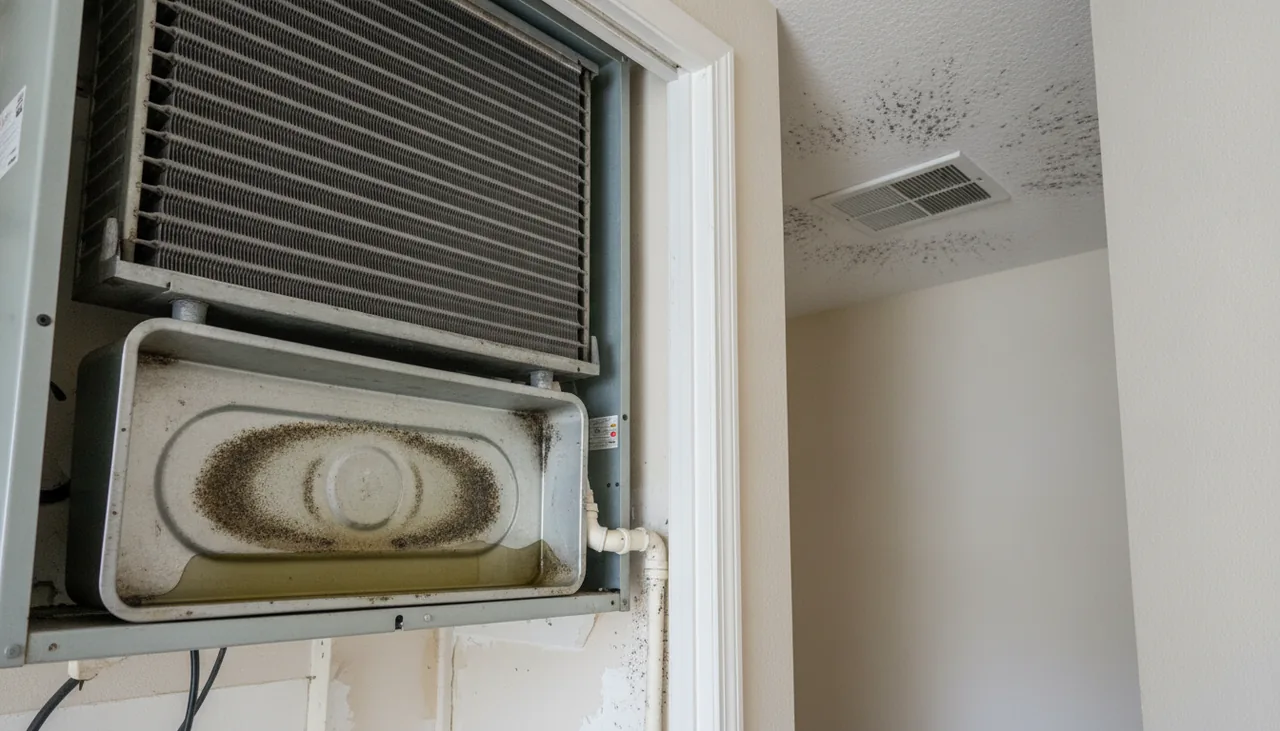
Where mold grows inside an HVAC system
- Evaporator coil and drain pan. Both are wet whenever the system cools, and dust that slips past a loose filter gives growth something to feed on. A pan that holds standing water is the usual starting point.
- Condensate line. Slime builds up inside the PVC drain until water backs into the pan, overflows into the secondary pan or the closet floor, and wets the platform under the unit.
- Air handler cabinet and blower. Fibrous lining inside the cabinet holds moisture, and the blower wheel collects growth on its blades and throws it down the supply trunk.
- Duct boots. The sheet-metal boxes behind each ceiling grille sweat where insulation has slipped and hot attic air touches cold metal, so the boot grows mold and drips onto the ceiling below.
- Flex duct. A torn outer jacket, a flattened bend or a sagging run lets humid attic air reach the cold inner liner. That liner cannot be cleaned once growth has taken hold.
- Return plenum and duct board. Fibreglass board in the return path picks up dust and moisture and grows on its inside face.
Signs that point to AC mold rather than a single leak
A smell that comes and goes with the system, dark rings on the ceiling around several grilles in different rooms with no leak above any of them, water in the secondary pan or a float switch that keeps shutting the unit off, and grilles that bead with water on summer afternoons all suggest the source sits in the equipment or the ductwork. When that is the pattern, the assessor opens the access panels, looks at the coil, pan and blower, checks a sample of boots and flex runs in the attic, and may compare air samples from the rooms against one taken outdoors.
The weather outside the house is a large part of why boots and grilles sweat in St. George.
Averaged from hourly readings at Baton Rouge Metropolitan Airport, the dew point runs about 71°F in June and 73°F in July and August (1996-2020). A supply boot carrying chilled air is far colder than that, so any gap in duct insulation or an unsealed boot collar collects water on contact.
Who assesses and who cleans HVAC mold under Louisiana law
Louisiana does not allow the firm that diagnoses mold on a property to be the firm paid to remove it, or to own part of that firm: La. R.S. 37:2158(A)(23). On a cooling system that means an independent assessor writes the protocol for the coil, pan, cabinet, ducts and affected rooms; a separate remediation contractor carries it out, with an HVAC technician for the drain, refrigerant and electrical side; and someone outside that contractor runs the clearance check with the blower on.
St. George Mold Remediation arranges those visits and keeps the documents in one file. It does not open air handlers or replace ductwork itself.
How HVAC mold remediation is done, from coil to duct boots
Shut down and seal. The system is switched off, supply grilles and the return are covered, and the work runs under HEPA-filtered negative air so debris from the equipment stays out of the rooms.
Coil, pan and condensate line. The coil is cleaned with a coil cleaner and flushed in place, or pulled for cleaning when access allows. A rusted or cracked pan is replaced. The condensate line is cleared, its trap rebuilt, a cleanout tee added and the float switch tried.
Cabinet and blower. The blower wheel comes out for cleaning. Internal lining with growth on it is removed and replaced or covered as the protocol directs.
Ducts and boots. Sheet-metal trunks are cleaned with mechanical agitation and a HEPA vacuum. Flex duct and duct board with growth on the inner surface are replaced rather than cleaned. Boots are cleaned or swapped, sealed with mastic and wrapped so warm attic air no longer reaches them.
Rooms near the grilles. Ceilings and walls where growth has settled are handled under containment; the mold remediation page describes that part.
The cause. Drain slope, insulation gaps on attic ducts, an oversized unit that cycles off before it removes moisture, or indoor humidity that needs a dehumidifier. A UV lamp at the coil can help keep that surface clean, but it does nothing for the drain, the boots or the flex runs.
Clearance. With the system back on, someone independent of the contractor checks the work and, if the protocol calls for it, samples the air.
Air duct cleaning is not duct mold remediation
A duct-cleaning service vacuums dust and debris out of the ductwork. It does not start from an assessment, does not open the air handler to treat the coil and pan, does not replace flex duct whose liner has grown mold, does not touch the ceilings around the grilles, and does not end with a check by someone independent. A fog blown through the vents does not remove anything either. If the ducts are only dusty, duct cleaning is the right service and the cheaper one. If the assessment finds growth, the protocol calls for remediation, and the cleaning crew is the wrong trade for it.
Keeping cool while HVAC mold work is under way
The system is off while it is open. Coil, pan and drain work usually fits inside a day or two; replacing flex duct and boots across an attic takes longer. When the assessment shows the problem can wait a little, many owners book duct replacement outside the hottest stretch of the year, and the contractor plans the shutdown around the household.
The length of the St. George cooling season is why that timing matters.
NOAA's 1991-2020 normals for the airport count about 96 days a year at 90°F or hotter, roughly 70 of them from June through August, and summer nights average 72.9°F. A planned shutdown is easiest to fit in outside those three months.
What HVAC mold remediation costs in St. George
The assessment with a written report is $300 to $600, or $450 to $850 with one or two air samples; extra air samples are $50 to $100 each. Cleaning the air handler and coil runs $1,500 to $5,500 depending on system size and access. Duct decontamination is $800 to $3,500 per system, set by duct length and how much has to be replaced. A whole-house job covering the equipment, the ductwork and the rooms the system has affected runs $6,000 to $20,000. Clearance with the blower running adds $200 to $400.
Treat these as estimates from earlier St. George systems; the remediation contractor's written quote, made from the assessment, is the number that counts. See the cost page for every range, and attic mold if the ducts run through a damp attic.
Booking an HVAC mold assessment
Call (225) 285-3983 and describe the smell or what you can see, which rooms are affected, roughly how old the system is, whether the air handler sits in a closet, the garage or the attic, and whether a duct cleaning has already been done. For a business or a rental with several units, the commercial page covers the scheduling side. The form below works if you would rather write.
HVAC, AC mold and air duct questions
How much does HVAC mold remediation cost in St. George?
Cleaning the air handler and coil runs $1,500 to $5,500, duct decontamination $800 to $3,500 per system, and a whole-house job with duct replacement and room work $6,000 to $20,000. Call (225) 285-3983 with the system's location and age for a closer range.
Is air duct cleaning enough if there is mold in the ducts?
Not when the assessment finds growth. Duct cleaning removes dust, but it leaves the coil, the pan, the cabinet lining and any flex duct with a contaminated liner untouched. Call (225) 285-3983 and book the assessment before paying for a cleaning.
Who cleans the coil and replaces the ducts if this company does not?
A separate remediation contractor, with an HVAC technician, working from a protocol written by an independent assessor, as La. R.S. 37:2158(A)(23) requires. Call (225) 285-3983 to have the assessor and the contractor booked in that order.
Should I keep running the AC if there is mold in it?
Every cycle moves air past whatever is growing on the coil, so run it as little as the weather allows and get the assessment on the calendar. Call (225) 285-3983 and mention how hot the house gets with the system off.
Does homeowners insurance pay for AC mold?
Growth from condensation or a clogged drain is usually treated as maintenance and excluded, while damage after a sudden covered loss may be different. Check the policy, then call (225) 285-3983 to have the assessment report ready for the adjuster.
Who pays to fix duct mold in a rented house?
The cooling system belongs to the building, so the owner normally pays, though a lease may assign filter changes to the tenant. The assessment shows what failed. Owners, managers and tenants can call (225) 285-3983 to request one.
Request a Callback
Writing it down suits some people better, and so does sending it after office hours. Put the details in here and a phone call comes back to you.
Talking it through instead? (225) 285-3983 picks up day or night; give the street address and what is wrong, and someone rings you back.
Musty smell whenever the AC runs?
Call (225) 285-3983 to have the air handler, drain pan and ducts assessed before any cleaning is booked.
Call (225) 285-3983