
Crawl Space Mold Removal in St. George, LA
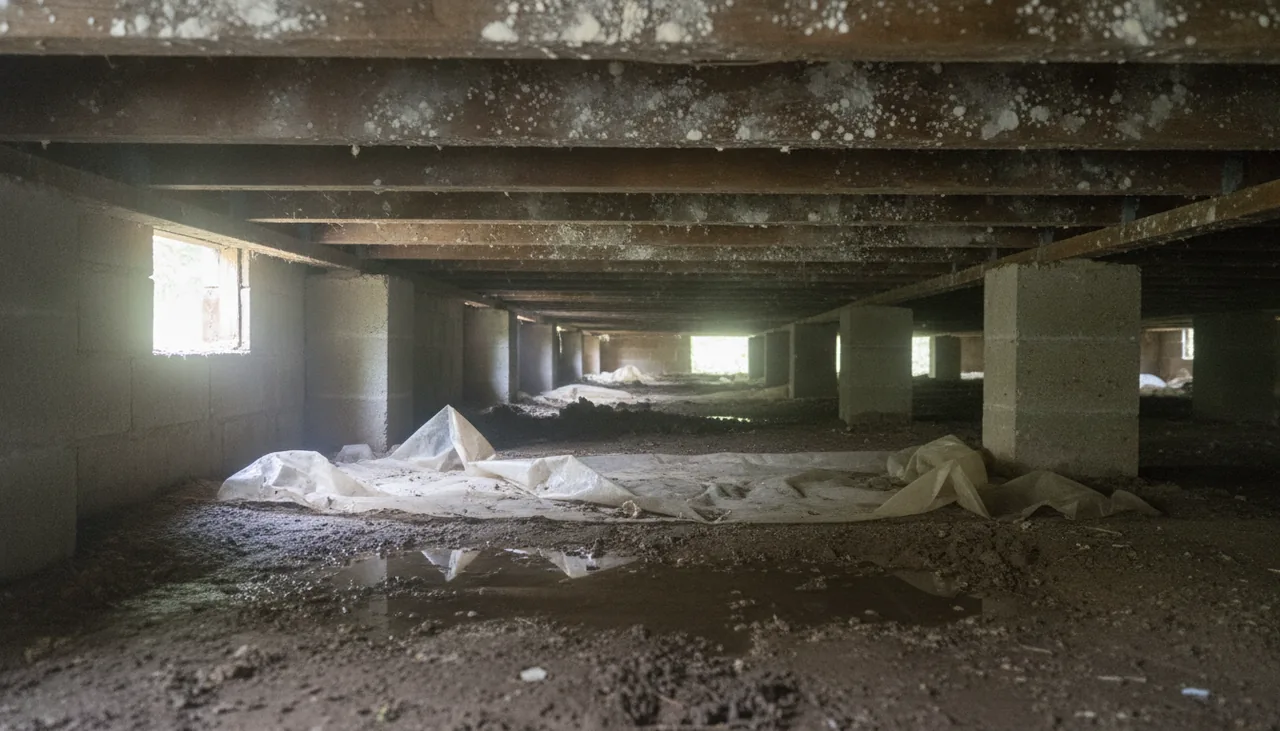
Crawl space mold shows up in St. George as a musty smell that is strongest at floor level, hardwood that cups or gaps with the seasons, insulation sagging between the joists, or grey and black growth on the wood when someone finally looks through a foundation vent. The fix has two halves that must both happen: the framing is cleaned under the house, and the moisture that fed it is stopped with a sealed ground liner or a full encapsulation. St. George Mold Remediation books an independent assessment firm to look underneath first, then a separate contractor for the work. Call (225) 285-3983.
Call (225) 285-3983 Request a callback
Why a crawl space under a St. George house stays damp
The wood under a raised floor rarely gets wet from a single event. It stays damp because several small sources add up, season after season:
- Summer air through the vents. Foundation vents let warm, humid outdoor air under the house. It meets joists and ducts cooled by the air conditioning above and condenses on them, the way a glass of iced tea sweats on a porch.
- Moisture rising from bare ground. Soil gives off water vapor all year. With no liner, or a liner that is torn, bunched or never sealed, that vapor goes straight into the framing.
- Water sent toward the house. Downspouts that empty at the foundation, beds graded toward the walls and a low lot that holds rain all push water underneath.
- Vents and pipes that end below the floor. A dryer duct or bathroom fan that discharges into the crawl space, a slow drain leak or an air handler condensate line can wet one area for years.
- Sweating ductwork. Supply ducts under the floor run cold, and loose or torn duct insulation drips onto the ground and the joists around it.
The ground under St. George houses adds its own share of that moisture.
NRCS soil data rate about four-fifths of the soil area in St. George (79.4%) as somewhat poorly to very poorly drained, and on 37.5% the water table rises to within about a foot of the surface at its shallowest. The most extensive soil, Oprairie silt, covers 20.8% of the city. Ground that wet keeps the air under a raised floor damp long after the rain stops.
Raised older houses, slab houses and crawl space mold
A slab house has no crawl space. Its hidden moisture shows up somewhere else, at the slab edge, in the bottom of exterior walls and under flooring, and that work is covered on the mold remediation page. A house raised on piers or a perimeter foundation is a different building: the whole floor system sits over open ground, and the smell, the cupping and the growth all start below.
Older raised houses carry extra history. Vapour barriers laid decades ago have usually failed, insulation added later is often the wrong kind for a damp space, and plumbing and ducts have been patched more than once. Some crawl spaces have also held floodwater at some point, which leaves silt and staining on the ground and the lower framing.
The age of the housing stock decides how many St. George homes have a crawl space at all.
Only about 17% of St. George's homes were built before 1980, against 43.5% across the parish (Census ACS 2020-2024, city estimate). The older stock sits mainly in the established neighborhoods, so a raised floor is far more likely on those streets than in the newer subdivisions.
How crawl space mold is removed
Black mold removal under a house follows the same protocol as any room above it; the crawl space itself becomes the containment. The work runs in this order:
- Assessment underneath. The independent assessor crawls the full space, takes moisture readings on joists, sills and subfloor, notes the liner, insulation, ducts, vents and plumbing, and writes the protocol.
- Containment. The access is sealed with plastic and a filtered air machine keeps the space under negative pressure, so nothing drifts up into the rooms while the work goes on.
- Removal. Wet or moldy insulation, the old liner and any debris the builders left are bagged and carried out. They are not reused.
- Framing cleaned. Joists, beams, sills and the underside of the subfloor are vacuumed with filtered equipment and cleaned by sanding, damp-wiping or media blasting, then treated where the protocol calls for it.
- Drying. Dehumidifiers run until the wood reads at the target set in the protocol.
- Keeping it dry. A sealed liner or a full encapsulation goes in, and new insulation goes back only once the wood is dry.
- Clearance. Someone other than the remediation contractor checks the space against the protocol.
Crawl space liner or full encapsulation
A ground liner is heavy polyethylene laid over the soil, lapped and taped at the seams and run a short way up the piers and foundation walls. It stops moisture rising from the ground. It does nothing about humid summer air entering through open vents and condensing on cold joists, so on its own it suits a crawl space with good drainage, few ducts underneath and no history of standing water.
Full encapsulation goes further: a thicker liner up the walls and around every pier, foundation vents closed, the access door sealed, and a dehumidifier or a small supply of conditioned air keeping the space dry year round. If water pools underneath after rain, a drain or sump is added first. Encapsulation suits houses with ductwork below the floor, floors that keep cupping or a smell that returns every summer.
Encapsulation is equipment, not a one-time job: the dehumidifier needs its filter and condensate line kept clear, and a gas furnace or water heater in the crawl space needs its combustion air checked before the vents are closed. Asking for both options priced side by side makes the choice easier to see.
Crawl space mold and the Louisiana two-firm rule
Under La. R.S. 37:2158(A)(23), the company that assesses mold on a property may not remediate it there, or own part of a firm that does. Crawl spaces are where that rule earns its keep. The firm that diagnoses the problem underneath is not the one selling the liner, the encapsulation or the dehumidifier, so the protocol states what the house needs rather than what a crew would like to install.
St. George Mold Remediation is a phone line and website that books those firms for St. George properties. It does not crawl under houses or remove mold. It books the independent assessor, then a separate remediation contractor, and keeps the clearance check with a third party. The assessment visit is described on the mold inspection page, and ducts that run through the crawl space are covered under HVAC mold remediation.
Crawl space mold removal cost in St. George
A crawl space is priced after someone has been underneath, because access, height, framing condition and drainage move the number more than square footage does.
- Assessment with crawl-space entry and written report: $375 to $750, which is the standard $300 to $600 inspection plus $75 to $150 for the entry.
- The work itself: $2,000 to $8,000 is the usual band. Cleaning the framing with a new sealed liner sits toward the lower end; full encapsulation with a dehumidifier sits toward the upper end.
- Clearance check under the house once the work is done: $200 to $400.
Treat these as a guide drawn from past St. George crawl spaces, not a price for yours. The written quote comes from the remediation contractor once the protocol exists. Every range is also on the cost page.
Before you call about the crawl space
A few details make the first conversation more useful: where the access is (a hatch in a closet floor or a door in the foundation), roughly how much clearance there is under the joists, whether the space has ever held water, whether floors are cupping or soft, and whether ducts or a furnace sit underneath. Call (225) 285-3983. Weekday office hours run from 8 in the morning to 6 in the evening and Saturday hours from 9 to 2, though the line takes crawl space calls at any hour. The callback form below and the contact page are there if you would rather write.
Crawl space mold questions from St. George owners
How much does crawl space mold removal cost?
It is priced after the assessment, which runs $375 to $750 with the crawl-space entry. The work itself usually runs $2,000 to $8,000, lower for cleaning plus a sealed liner and higher for full encapsulation with a dehumidifier. Call (225) 285-3983 with the size of the house and where the access is.
Is a vapor barrier enough, or does the crawl space need full encapsulation?
A sealed liner handles moisture from the ground. If ducts run underneath, floors keep cupping or the space has held water, encapsulation is usually the better fit. Call (225) 285-3983 and ask for both options priced side by side.
Is black mold on the floor joists handled differently from white mold?
No. Color does not decide the method; the protocol is set by how much growth there is, how wet the wood is and what is feeding it. Black mold removal under a house follows the same steps as any other. Call (225) 285-3983 and describe what you can see through the vent.
Will the musty smell inside the house go away?
Air from the crawl space rises into the rooms through gaps around pipes, ducts and floorboards, so the smell usually fades once the framing is cleaned and the space is kept dry. If it lingers, the ducts are the next place to look. Call (225) 285-3983 if the smell outlasts the work.
Does homeowners insurance cover crawl space mold?
Growth from years of humid air or a failed liner is usually treated as maintenance and excluded. A sudden pipe break under the house may be covered, often with a mold cap, and water that rose from outside is a flood claim. Phone (225) 285-3983 and get the cause on record before calling the carrier.
I am selling or renting out a raised house with crawl space mold. What helps?
Paperwork: the assessment report, the remediation invoice, the clearance result and the liner or dehumidifier details. Buyers and tenants both react to a musty smell, and documents answer the question it raises. Call (225) 285-3983 to set up an independent assessment before listing or signing a new lease.
Request a Callback
Writing it down suits some people better, and so does sending it after office hours. Put the details in here and a phone call comes back to you.
Talking it through instead? (225) 285-3983 picks up day or night; give the street address and what is wrong, and someone rings you back.
Musty air coming up through the floor?
Call (225) 285-3983 to have the crawl space assessed before anyone quotes a liner or encapsulation.
Call (225) 285-3983