
Bathroom Mold Removal in St. George, LA
Shower mold that creeps back into the grout a few weeks after a cleaning, a grey bloom across the ceiling paint, or a soft patch of wall beside the tub: these are the usual reasons St. George owners ask about bathroom mold. Some of it is surface growth fed by steam that never leaves the room. Some of it is water slipping past a shower pan or a cracked grout line into the wall cavity. St. George Mold Remediation books an independent assessor to tell which one you have, then a separate remediation contractor to open and dry the wall when that is what the report finds. Call (225) 285-3983.
Call (225) 285-3983 Request a callback
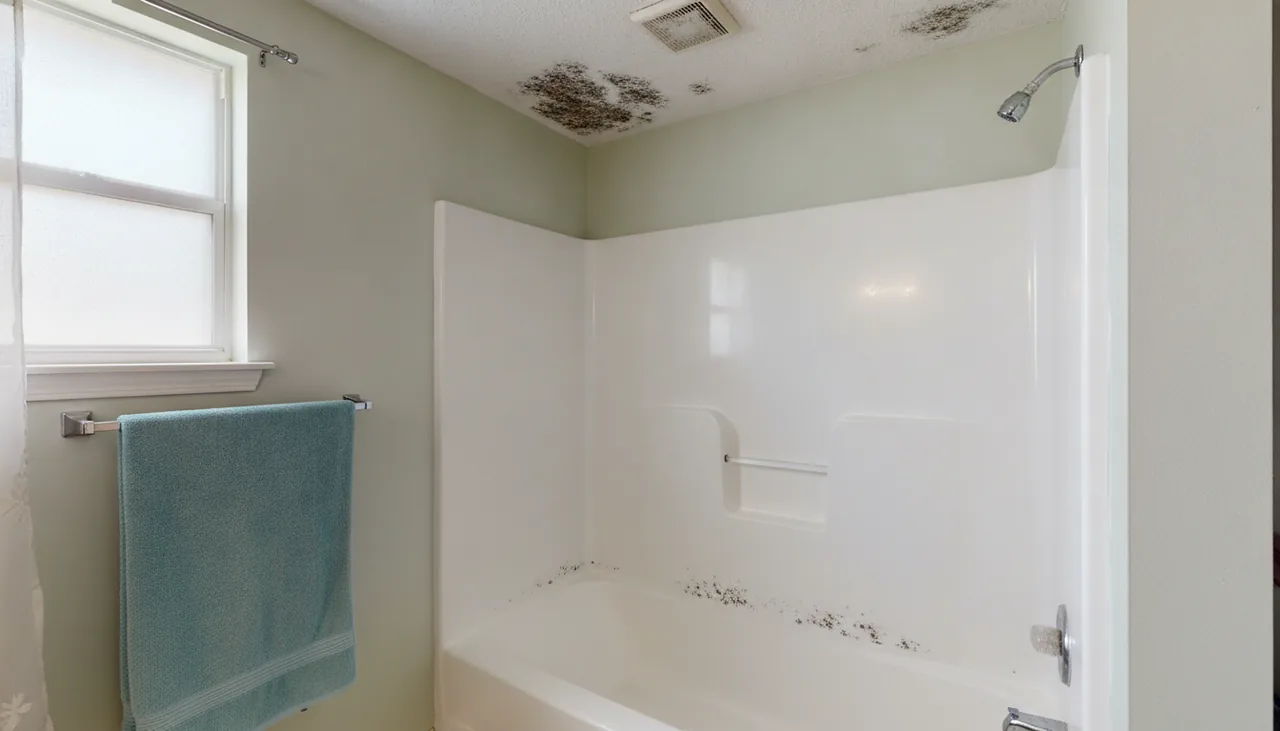
Surface bathroom mold, or water inside the wall?
Growth that stays on the surface looks like grey or black speckling on the ceiling paint above the shower, dark lines along the grout, caulk that has turned black from underneath, and a ring of growth around a window frame. It lives on the film of moisture left after hot showers in a room that does not dry out.
Water getting into the wall shows itself differently: tiles that sound hollow when tapped or shift underfoot, grout cracking where the tub meets the wall, paint blistering on the bedroom or closet side of the shower wall, a swollen baseboard outside the shower door, a stain on the ceiling under an upstairs bath, or a musty smell from the vanity with nothing to see. In those cases the drywall, the insulation and sometimes the subfloor have taken on water, and work on the visible surface does not reach them.
The assessor separates the two with a moisture meter and a thermal camera, so a wall is opened because the readings say so, not on a hunch.
Who deals with bathroom mold, and why it takes separate firms
A Louisiana mold remediation contractor cannot remediate a bathroom it also assessed, and cannot hold a share in the firm that assessed it; that line is drawn in La. R.S. 37:2158(A)(23). For a bathroom the sequence is an independent assessment that finds the wet area and writes the removal protocol, then a separate remediation contractor who opens the wall and dries it, then a check of the open cavity by somebody other than that contractor before the new backer board goes on. A plumber repairs the leak in the middle of that sequence.
St. George Mold Remediation lines up those visits and keeps the report, the quote and the clearance together. It does not open walls or take samples itself.
How a bathroom mold job behind the tile is carried out
- The source is found. Common culprits are a failed shower pan liner, a cracked drain gasket, a leaking valve or supply stub behind the trim plate, a tub overflow gasket, or a toilet wax ring that has let go.
- The room is closed off. Sheeting with a zippered flap covers the doorway, the exhaust grille is masked, and a HEPA-filtered air machine draws air out so dust from the wall does not drift into the bedrooms.
- Wet material comes out. Tile and backer board are removed where they sit on damp framing, along with drywall and insulation past the wet edge. Everything leaves in sealed bags.
- The framing is treated. Studs, bottom plates and subfloor are sanded where growth has marked them, HEPA-vacuumed and treated. Subfloor that has gone soft is cut out and replaced.
- The cavity dries and is checked. Dehumidifiers run until the wood meets the protocol's target, then someone independent of the contractor checks the open area.
- The bathroom is rebuilt. New backer board, a waterproofing membrane, tile, drywall and paint. The rebuild is priced as its own line, so you can bring your own tile setter if you prefer.
For growth that has spread beyond one room, the mold remediation page covers the larger job.
Why shower mold keeps returning in St. George bathrooms
Because the room never gets dry. The usual reasons are an exhaust fan ducted into the attic instead of outdoors (which also feeds attic mold), a fan too small for the room, a fan nobody switches on, a bathroom built with no fan at all, a curtain left bunched against the tile, and new caulk laid over old blackened caulk. Clearing the visible growth buys a few weeks; venting the room to the outdoors through the roof or a wall, on a timer or humidity switch, is what changes the outcome.
Outdoor air in St. George carries a lot of moisture for much of the year, which stretches out the time a closed bathroom needs to dry.
Hourly observations at the nearest airport station put the summer dew point near 71°F in June and 73°F in July and August (NOAA, 1996-2020). Air that wet does little to dry a shower wall when it is pulled in through an open window, which is why a fan ducted outdoors matters more here than in drier places.
Bathroom mold in older and newer St. George houses
Bathrooms age in predictable ways. Older ones often have tile set on drywall or a mortar bed with no membrane behind it, a window instead of a fan, and supply valves that have been in the wall for decades. Newer ones usually have a fan and cement board, but a builder-grade fan ducted only as far as the attic floor is common, and a shower pan installed without enough slope can hold water for years before anyone sees a sign of it.
In ZIP 70810, which lies mostly inside the city, the median home was built in 1997 and the 2000s were the busiest building decade, at 23.5% of homes (Census ACS 2020-2024). Inniswold's median house dates from 1995 and Oak Hills Place's from 1998 (ACS 2019-2023), so many bathrooms on those streets are of the newer kind.
What bathroom mold removal costs in St. George
A ceiling, grout and caulk job on an area under 10 sq ft, with the fan corrected, sits in the $500 to $1,500 range. Opening the wall behind the tub or shower, removing wet drywall and insulation, treating the framing and drying the cavity runs $1,500 to $4,500, and the tile and drywall rebuild is priced on top. The assessment with a written report is $300 to $600; an air sample is $50 to $100 and a surface sample $40 to $80, lab included, only when the protocol calls for one. A clearance test afterwards is $200 to $400. A fan vented to the outdoors is added as a separate line.
All of these are estimates drawn from past St. George bathrooms. The remediation contractor sets the actual price in writing after reading the assessment. The cost page lists every range.
Booking a visit for bathroom mold
Phone (225) 285-3983 and say which bathroom it is, whether the wall feels soft or the tile moves, whether there is a fan and where it vents, and whether the bathroom sits above another room. If the house is a rental or under contract, mention that too. Prefer writing? Use the form below or the contact page. Dark growth in other rooms is covered on black mold removal.
Bathroom mold and shower mold questions
How much does bathroom mold removal cost in St. George?
Surface growth on a ceiling, grout or caulk under 10 sq ft falls within $500 to $1,500. Opening and drying the wall behind a shower runs $1,500 to $4,500, with tile and drywall priced on top. Call (225) 285-3983 and describe the bathroom for a closer range.
Who fixes shower mold that is coming from inside the wall?
A separate remediation contractor opens and dries the wall after an independent assessor has written the protocol, and a plumber repairs the leak; La. R.S. 37:2158(A)(23) keeps assessment and removal with different companies. Call (225) 285-3983 to set that order up.
Is it worth opening the wall for bathroom mold?
When the moisture readings show wet framing behind the tile, yes, since nothing done on the surface reaches it. When the readings are dry, the fix is usually ventilation and new caulk. Call (225) 285-3983 and let the assessment readings decide.
Does homeowners insurance cover mold behind a shower?
Slow seepage from a shower pan or grout is often excluded, while a sudden pipe failure may be covered, and many policies cap mold. Read your policy, and call (225) 285-3983 to have the independent assessment ready for the adjuster.
Should a seller deal with bathroom mold before listing the house?
A soft shower wall tends to surface on the buyer's inspection anyway. An assessment and a clearance letter give the seller paper to show instead of a question mark. Call (225) 285-3983 before the listing goes live.
Who is responsible for bathroom mold in a rented house or apartment?
A leaking pan or valve is the owner's repair, while a fan that is never switched on is often the tenant's habit; the assessment report shows which applies. Landlords and tenants can each call (225) 285-3983 to request it.
Request a Callback
Writing it down suits some people better, and so does sending it after office hours. Put the details in here and a phone call comes back to you.
Talking it through instead? (225) 285-3983 picks up day or night; give the street address and what is wrong, and someone rings you back.
Bathroom growth that returns after every clean?
Call (225) 285-3983 and have the wall behind the tub or shower checked for a leak.
Call (225) 285-3983