
Mold Inspection & Testing in St. George, LA
A mold inspection in St. George is the step that decides everything after it: whether anything has to be removed, how much, and which repair stops the water. St. George Mold Remediation books that assessment with an independent firm that will not bid on the removal, so its findings carry no sales pitch. The assessor reads moisture in walls and floors, checks the attic, the air handler closet and any crawl space, and adds mold testing only when a sample settles a real question. You receive a written report that a separate contractor can price from. Call (225) 285-3983 to book.
Call (225) 285-3983 Request a callback
Reasons to book a mold inspection
- A smell with no visible source. A musty odour in one room or closet, with nothing showing, usually points to something inside a wall cavity, under flooring or above a ceiling.
- Stains that return. A ceiling mark below the air handler, or a bathroom that darkens again a few weeks after being painted.
- Water that sat. A supply line, roof or appliance leak that stayed wet longer than the 24 to 48 hours the Louisiana Department of Health gives for drying.
- A transaction. A purchase, a listing, a lease change or a claim, where somebody needs findings on paper rather than a phone photo.
- Finished remediation. A removal job that needs looking over by someone other than the contractor who did it.
What happens during the mold assessment visit
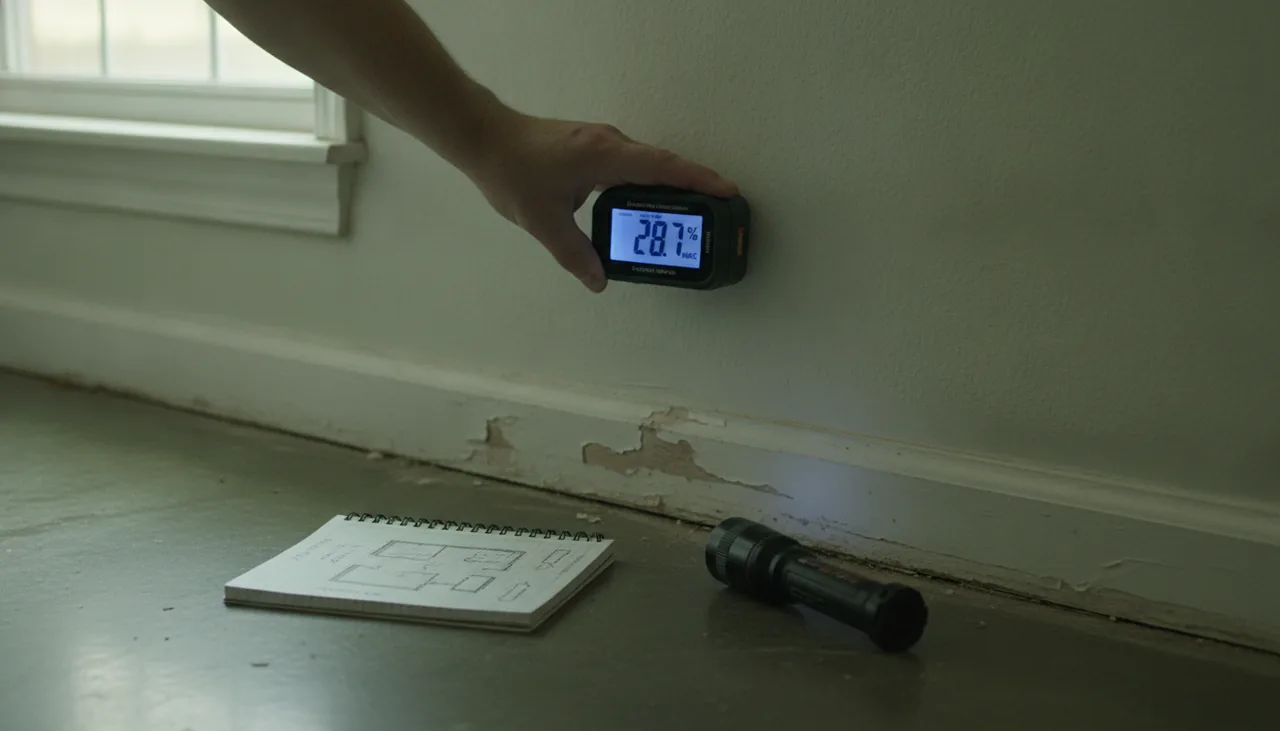
The assessor begins with how the building was put together and where water could get in, then works through it room by room. A moisture meter on drywall, baseboards and subfloor finds wet material behind sound paint. A thermal camera picks out cool, damp bands along a slab edge or under a window. In the attic the assessor looks for a stained roof deck or a bath fan that ends in the insulation; in the air handler closet, for a rusty pan or a sweating plenum; under a raised house, for wet joists and a torn ground liner.
Housing age shapes where that time goes. In ZIP 70817, which lies almost entirely inside St. George, the median home was built in 1994 and only 17.2% of homes predate 1980 (Census ACS 2020-2024), so slab edges, attics and air handler closets take up most visits; on older streets the assessor allows longer for the original framing and plumbing.
Findings go onto a sketch of the floor plan, with readings and photos beside each area. The report closes with a protocol: the moisture source to repair, which materials come out and how far past the visible edge, the containment, the drying targets, and how the finished work will be checked.
Mold testing: what samples can and cannot show
Sampling is a tool inside the inspection, not a replacement for it. An air sample draws a measured volume of room air across a collection cassette, with a matching sample outdoors for comparison. A tape lift or swab from a surface tells the lab what is growing there. Neither locates hidden growth or names the leak, which is why a lab result on its own leaves you with a number and no plan.
When growth is visible and the cause is plain, a sample rarely changes what has to be done. Mold testing earns its cost when a buyer or tenant needs documentation, when growth is suspected inside a closed wall nobody wants to open blind, or when a clearance check needs a before-and-after comparison. A careful assessor samples to settle a specific question, not one cassette per room.
Why the mold inspection firm cannot do the removal
Louisiana keeps whoever diagnoses a mold problem away from the money for fixing it. La. R.S. 37:2158(A)(23) prohibits one company from carrying out both the assessment and the remediation on a property, and from owning part of both firms. So the report travels from the independent assessor to a separate remediation contractor for pricing, and once the work is finished, someone other than that contractor checks it.
That arrangement is what makes the report useful to people besides you. An adjuster, a buyer's agent or a second contractor can read the same protocol and judge or price the same scope. The mold remediation page describes the work that follows.
Mold inspection cost in St. George
For a St. George house, an inspection with a written report is $300 to $600. Getting under an older raised house adds $75 to $150 for crawl-space entry, so a house with a crawl space usually lands at $375 to $750. A visit that includes one or two air samples runs $450 to $850. Further air samples are $50 to $100 each and surface samples $40 to $80 each, lab fees included. A clearance test after remediation costs $200 to $400, or $100 to $200 per room when only clearance samples are needed. The price table shows how these sit beside the removal ranges.
Mold inspection when buying or selling in St. George
Mold questions tend to surface late in a sale: a home inspector notes a stain, the crawl space smells, or the seller's disclosure mentions past water. An assessment ordered during the inspection period gives both sides the same written scope to negotiate from, and a seller who has already had remediation done can show the clearance result beside it.
Flood history is part of that conversation here. The City's planning documents put 43% of St. George's land in FEMA's Special Flood Hazard Area, and the City's own flood-zone layer, clipped to the city limits, gives 51.6% once the floodway and Zone A are counted. ZIP 70817 alone produced 1,360 flood-insurance claims in August 2016.
Ask the assessor to record flood-related findings on their own, such as a water line on framing or replaced lower drywall, since a buyer's insurer or lender may ask about past water.
Booking a mold inspection in St. George
Phone (225) 285-3983 with the address, roughly how big the building is, whether it sits on a slab or on piers, and what made you call. Mention any deadline, such as a closing date or an adjuster's visit, because it shapes what the report has to cover. The callback form below is there if writing is easier.
Mold inspection and mold testing questions
How much is a mold inspection in St. George?
$300 to $600 for a house with a written report, $450 to $850 when one or two air samples are included, and $75 to $150 more for crawl-space entry. Call (225) 285-3983 for a figure that fits the building.
Is mold testing worth paying for?
Sometimes. When growth is visible and the cause is clear, samples seldom change the plan; when a buyer, tenant or adjuster needs documentation, or growth may be hidden in a wall, they help. Call (225) 285-3983 and ask whether sampling suits your case.
Can the inspection company do the mold removal as well?
No. Louisiana law, La. R.S. 37:2158(A)(23), keeps the assessing firm and the remediating firm apart on any one property. Call (225) 285-3983 and a separate contractor is lined up once the report is in.
Should I get a mold inspection before buying a house?
If the house took water, smells musty or has a stained ceiling, yes, and order it while the inspection period is still open so the findings can shape the price. Call (225) 285-3983 with the closing date.
What does the written report include?
Moisture readings, photos, a marked floor plan, the likely water source, and a protocol covering removal, containment, drying targets and the final check. Call (225) 285-3983 if a lender, landlord or adjuster needs a copy.
Who tests the house after the mold is removed?
Someone other than the remediation contractor, so the company that did the work is not grading it. Call (225) 285-3983 and the clearance check is scheduled together with the job.
Request a Callback
Writing it down suits some people better, and so does sending it after office hours. Put the details in here and a phone call comes back to you.
Talking it through instead? (225) 285-3983 picks up day or night; give the street address and what is wrong, and someone rings you back.
Want to know what is growing and where the water comes from?
Call (225) 285-3983 to book an assessment by a firm that will not be bidding on the removal.
Call (225) 285-3983