
Mold Remediation in St. George, LA
Mold removal in a St. George house starts with a question most people skip: where is the water coming from? St. George Mold Remediation is a phone line and website that sets up the whole job for properties inside the City of St. George. It does not do the inspection or the removal itself. An independent assessment firm finds the moisture and maps the growth, a separate remediation contractor takes out what has to go, and someone other than that contractor checks the result before the walls close. Tell us what you are seeing and we line up each step. Call (225) 285-3983.
Call (225) 285-3983 Request a callback
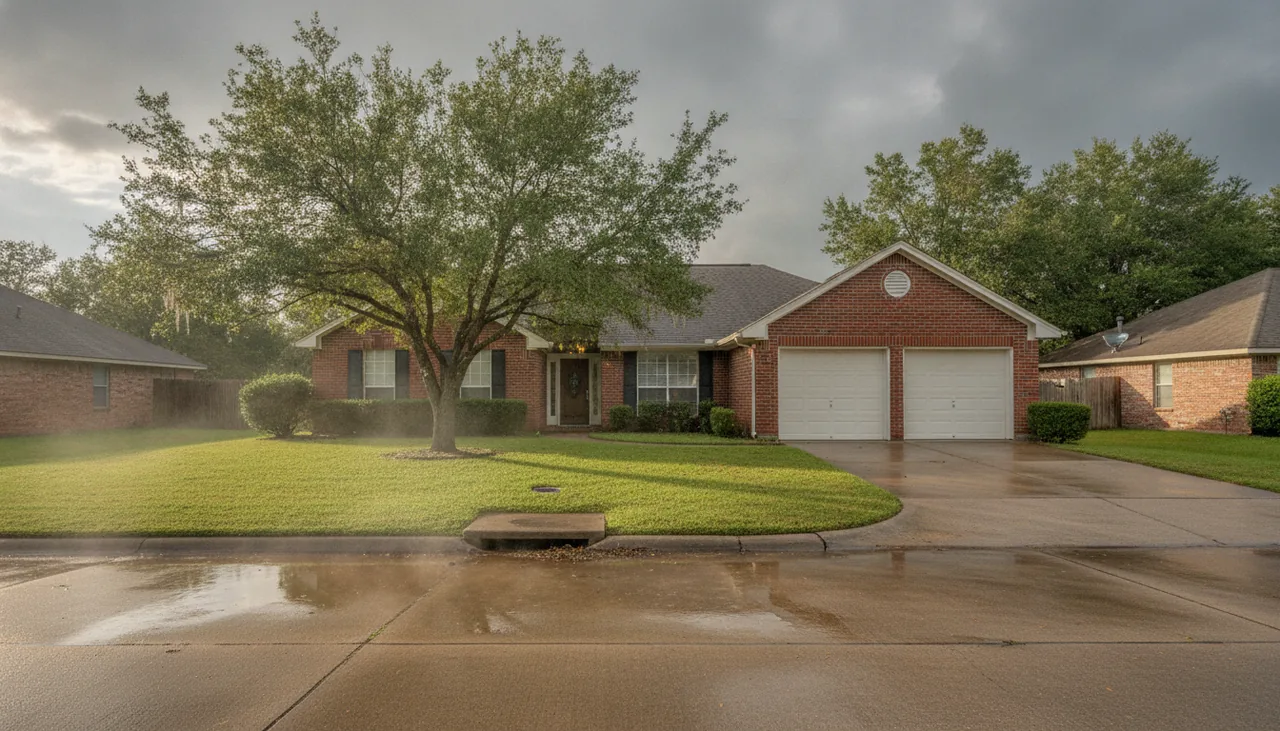
Mold removal and related services in St. George
Each service below has its own page with the details, prices and questions that apply to it. All of them follow one pattern: an independent assessment first, removal by a separate contractor, then a check by someone other than that contractor.
- Mold remediation: the full controlled job, with the work area sealed, damaged material cut out, framing cleaned, the space dried and the result checked.
- Mold inspection and testing: an assessor with no stake in the removal traces the moisture, maps the growth and writes the scope, with lab samples only where they answer something.
- Water damage restoration: extraction and drying after a burst line, an appliance leak or a roof opened by wind, ideally before growth gets a start.
- Black mold removal: dark growth is handled under the same containment as any other kind, because its colour says little about what it is.
- Crawl space mold: joists, subfloor and sill plates over damp ground under raised houses.
- Attic mold removal: roof decking darkened by leaks, poor ventilation or exhaust fans that end in the insulation.
- Bathroom mold removal: growth behind tile and tub surrounds where a shower pan or valve has been seeping.
- HVAC and duct mold: the air handler, evaporator coil, drain pan and duct runs that carry growth from one closet to every room.
- Post-flood mold remediation: houses where high water reached the walls and the drywall was closed up before the framing dried.
- Commercial mold remediation: offices, shops, churches and rental buildings, with work planned around opening hours and tenants.
- Mold removal cost: every price range used on this site, what moves each one and how to compare quotes.
- Service area: the City of St. George, including Shenandoah, Inniswold, Old Jefferson, Oak Hills Place, Village St. George and Westminster, and the Highland Road, Jefferson Highway, Airline Highway, Siegen Lane, Perkins Road and Bluebonnet corridors.
Why St. George homes keep needing mold removal
Growth indoors needs warmth, something to feed on such as drywall facing or wood, and moisture that lingers. A house here supplies the first two nearly all year. The third is what every job has to track down, and the local climate, the way houses were built and the way water moves across this part of the parish explain where it usually turns up.
The closest long-running weather record, at Baton Rouge Metropolitan Airport about 10 miles from City Hall, averages 61.94 inches of rain a year under NOAA's 1991-2020 normals, and measurable rain falls on about 114 days. Hourly observations there put the July and August dew point near 73°F.
Damp outdoor air is only part of the story. It turns into water at the cool surfaces an air conditioner creates: a supply duct sweating in the attic, a drain pan that empties slowly, a grille that drips onto the ceiling below. It also soaks into materials that wick water up from a slab edge or down from a roof flashing.
The houses themselves are younger than in much of the parish. Only about 17% of the city's roughly 34,100 homes were built before 1980, about 44% date from 2000 or later, and about three in four occupied homes are lived in by their owners (Census ACS 2020-2024, city estimate).
Then there is water that arrives all at once. When a bayou or creek leaves its banks, or wind lifts shingles, the clock starts: the Louisiana Department of Health advises drying wet building materials within 24 to 48 hours. Walls that were closed up wet after high water turn into some of the largest mold removal jobs a house can need.
August 2016 showed how much water this ground can take. The airport gauge caught 17.15 inches over August 11-13, and the Amite River at Bayou Manchac Point, on the city's eastern edge, rose to an estimated record 21.50 feet, 12.5 feet above flood stage (National Weather Service). FEMA flood-insurance data place about 1,700 claims from that month inside today's city limits (estimate).
Who does each part of a mold removal job
Louisiana splits diagnosis from repair. Under La. R.S. 37:2158(A)(23), one company cannot act as both assessor and remediator on a given property, and cannot hold an ownership stake in the firm handling the other half. The rule exists so that whoever writes the scope does not profit from making it bigger.
- The assessor. An independent firm traces the moisture, maps the growth, samples only when a question calls for it, and writes a protocol stating what comes out, how the area is sealed and what dry readings the materials must reach.
- The remediation contractor. A separate company prices the work from that protocol rather than from its own sales visit, then builds containment, removes damaged material, cleans what stays and dries the space.
- The final check. Someone other than the remediation contractor looks over the finished area, and on larger jobs takes clearance samples, before any drywall goes back.
St. George Mold Remediation is none of those three. It is the phone line that books the assessment, sends the report out for a written remediation price, and schedules the check at the end, so you are not the one chasing three businesses. Because the scope comes from a firm that earns nothing from the removal, a small problem stays small on paper.
Mold removal costs at a glance
The figures below are the ranges this site uses for St. George work. The cost page lists every job type with what moves it.
- Assessment and written report: $300 to $600, or $450 to $850 including one or two air samples.
- Small area under 10 sq ft: $500 to $1,500.
- Closet or bedroom: $1,200 to $3,800. Bathroom opened behind the wall: $1,500 to $4,500.
- Slab-edge cavity opened and dried: $2,000 to $7,000.
- Attic: $2,500 to $8,000.
- Air handler and coil: $1,500 to $5,500. Whole-house HVAC and ducts: $6,000 to $20,000.
- A full floor closed up wet after a flood: $10,000 to $30,000 or more.
- Clearance check at the end: $200 to $400.
Treat these as estimates drawn from earlier jobs rather than a quote. The figure to plan around is the remediation contractor's written price after reading the assessor's protocol, and it can come in above or below the range.
Getting started with mold removal in St. George
Call (225) 285-3983 and describe what you have noticed, where in the building, and whether there was a leak, a storm or high water. On weekdays the office keeps hours from 8 a.m. to 6 p.m., and on Saturday from 9 a.m. to 2 p.m.; the line picks up outside those times as well.
If a sale, a lease or an insurance claim is involved, say so at the start, because the report may need to be written with that reader in mind. Prefer writing? Use the callback form below or the contact page.
Mold removal questions from St. George owners
How much does mold removal cost in St. George?
It turns mostly on how much material has to come out. A small area under 10 sq ft runs $500 to $1,500, a closet or bedroom $1,200 to $3,800 and an attic $2,500 to $8,000, and the assessment that sets the scope is $300 to $600. Call (225) 285-3983 for the range that fits your house.
Can one company find the mold and then remove it?
Not in Louisiana. La. R.S. 37:2158(A)(23) requires the assessor and the remediation contractor on a property to be unrelated businesses. Call (225) 285-3983 and both are booked for you.
Is it worth paying for an assessment before the removal?
In most cases, yes. A scope written by a firm that earns nothing from the removal keeps a small job small, and it names the water source so the work is not repeated next year. Call (225) 285-3983 and ask for the assessment first.
Will homeowners insurance pay for mold removal?
Sometimes. A policy tends to respond when mold follows a sudden covered event, such as a split supply hose, and often caps the mold portion; slow leaks and long-term humidity are commonly excluded. The assessment report and photos are what an adjuster looks for. Call (225) 285-3983 with your claim number handy.
We are buying or selling a house with mold. What should happen first?
An independent assessment, ordered while the contract still allows it, so the price discussion rests on a written scope instead of a photo. A seller who has already had the work done can share the clearance result as well. Call (225) 285-3983 and mention the closing date.
Who deals with mold in a rental, the landlord or the tenant?
Under most leases the owner arranges the repair, and the tenant reports the leak or smell in writing as soon as it shows up. An independent report keeps the discussion on readings and photos. Landlords and tenants can both call (225) 285-3983.
Request a Callback
Writing it down suits some people better, and so does sending it after office hours. Put the details in here and a phone call comes back to you.
Talking it through instead? (225) 285-3983 picks up day or night; give the street address and what is wrong, and someone rings you back.
Mold in a St. George house?
Phone (225) 285-3983 with the address and what you are seeing. An independent assessment comes first, then a separate contractor prices any removal.
Call (225) 285-3983